


Why Sunscreen Matters for Sensitive Skin: A Science-Backed Guide
TL;DR:
- Daily broad-spectrum sunscreen protects sensitive skin from UV-induced inflammation and cellular damage.
- Choosing the right formula and applying enough sunscreen helps prevent barrier breakdown and aging signs.
Daily, broad-spectrum sunscreen is non-negotiable for sensitive skin. UV exposure drives inflammation, breaks down the skin barrier, and causes cumulative cellular damage that both worsens sensitivity and accelerates visible aging. If you have reactive skin, skipping sunscreen doesn’t protect you from irritation. It guarantees more of it over time.
Two things to do right now:
- Choose broad-spectrum SPF 30+ at minimum. If your skin reacts easily, start with a fragrance-free, tinted mineral formula and patch-test before committing to daily use.
- Patch-test every new sunscreen on your inner forearm or behind the ear for 24–48 hours before applying it to your face.
Table of Contents
- Why does UV radiation hit sensitive skin harder?
- Mineral, chemical, or hybrid: which sunscreen filter suits sensitive skin?
- How to choose a sunscreen that won’t irritate sensitive, aging skin
- How to apply sunscreen for sensitive skin without triggering flare-ups
- Does sunscreen cause absorption problems or irritation? What the evidence says
- How sunscreen protects your cellular repair and anti-aging results
- When should you see a dermatologist about sunscreen reactions?
- Key Takeaways
- Sunscreen first, then treat: a practical view
- Cellure’s repair serums work alongside your daily sunscreen
- Selected sources and further reading
Why does UV radiation hit sensitive skin harder?
Sensitive skin already has a compromised barrier, which means UV radiation doesn’t just cause surface redness. It triggers a cascade of damage that goes deeper. UVA rays penetrate into the dermis and generate free radicals that break down collagen and elastin. UVB rays damage DNA in keratinocytes directly. For sensitized skin, both processes happen against a backdrop of chronic low-grade inflammation, so the response is amplified and the recovery is slower.
2026 peer-reviewed research confirms that people with sensitive skin show worse erythema, higher transepidermal water loss (TEWL), and greater barrier dysfunction after UV exposure compared to non-sensitive controls. That means every unprotected hour outdoors isn’t just a cosmetic concern. It’s actively undoing barrier repair.
The cumulative picture matters too. Repeated low-level UV exposure, even on cloudy days or through windows, degrades collagen steadily. UVA penetrates glass, so sitting near a window while working still counts as exposure. Over years, this oxidative stress reduces the skin’s ability to repair itself at the cellular level, making every regenerative treatment you invest in less effective.
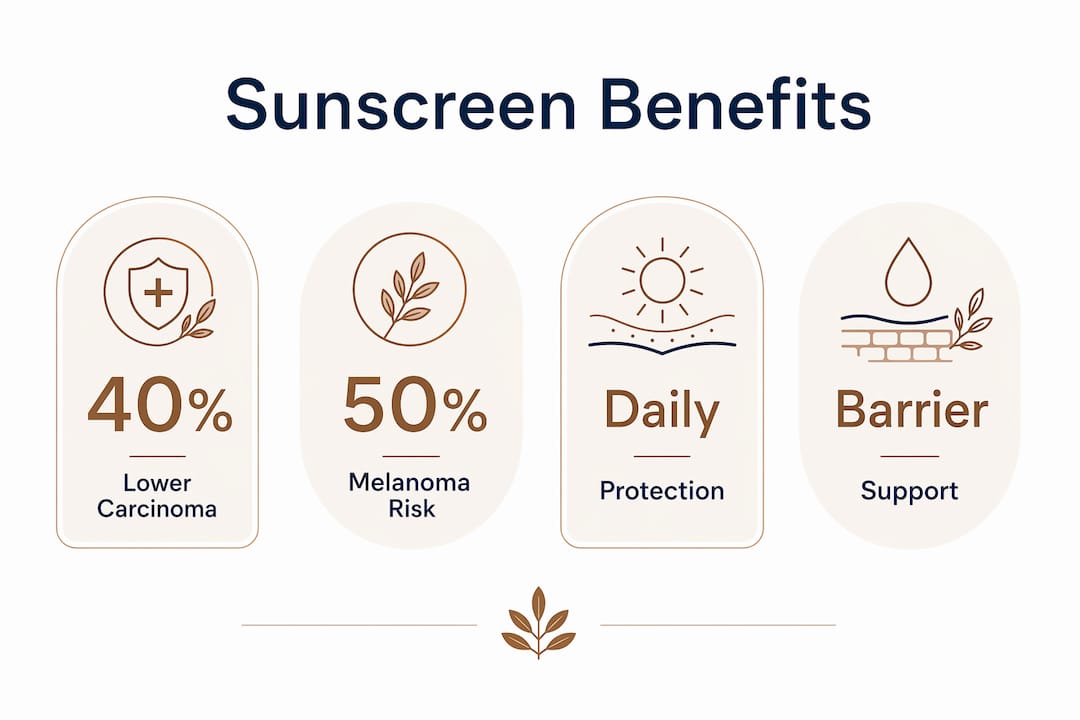
Daily use of sunscreen reduces squamous cell carcinoma risk by about 40% and melanoma risk by as much as 50%, according to the Skin Cancer Foundation. For sensitive skin, the anti-aging and barrier-preservation argument is just as compelling.
Mineral, chemical, or hybrid: which sunscreen filter suits sensitive skin?
The short answer: both mineral and chemical filters can protect you. The one you’ll actually wear every day without skipping is the right choice. That said, filter type does matter for sensitive skin in specific ways.

| Feature | Mineral (physical) | Chemical (organic) | Hybrid |
|---|---|---|---|
| Mechanism | Reflects/scatters UV on skin surface | Absorbs UV and converts to heat | Both mechanisms combined |
| Onset of action | Immediate | 30 min after application | Varies by formula |
| Irritation risk | Lower; less likely to sting | Higher for some (avobenzone, oxybenzone) | Moderate; depends on ratio |
| White cast | Common, especially on deeper skin tones | None | Minimal to none |
| UVA coverage | Good (zinc oxide); titanium dioxide covers less UVA | Often broader long-wave UVA coverage | Can be optimized |
| Barrier effects | Sits on surface; no penetration | Some absorption into skin | Reduced penetration vs. pure chemical |
Stanford Medicine dermatologists note that mineral sunscreens are the standard recommendation for sensitive skin, but chemical filters often cover long-wavelength UVA better. The 2026 research on hybrid organic/inorganic filter combinations found they can actually improve TEWL and hydration while reducing erythema and roughness in sensitive patients, which is a meaningful shift from the older “mineral only” advice.
Practical recommendations:
- Choose tinted mineral if you have rosacea, eczema, or a history of stinging from chemical filters. Tinted formulas also reduce white cast without sacrificing the sensitivity benefits, making them a practical option for sensitive skin types across all skin tones.
- A vetted hybrid may work if you need broader UVA coverage and have tested that chemical filters don’t trigger your skin.
- Avoid formulas with fragrance, high alcohol content, PABA, or unstabilized avobenzone. These are the most common culprits behind contact dermatitis in susceptible skin.
For a side-by-side breakdown of mineral versus chemical filters from an ingredient perspective, this independent comparison covers the key trade-offs clearly.
How to choose a sunscreen that won’t irritate sensitive, aging skin
Shopping for sunscreen with reactive skin is less about finding the “best” product and more about eliminating the ones that will cause problems. Use this checklist:
- Broad-spectrum label — must protect against both UVA and UVB.
- SPF 30 at minimum — SPF 50+ gives a practical buffer for the under-application most people do.
- Fragrance-free and dye-free — these are the two most common sensitizers in sunscreen formulas.
- Hypoallergenic and non-comedogenic — especially if you’re prone to breakouts alongside sensitivity.
- Soothing additives — ceramides, hyaluronic acid, or niacinamide support barrier repair alongside protection.
- Dermatologist-tested — not a guarantee, but a useful signal for formulas that have been evaluated for reactive skin.
The AAD recommends zinc oxide and titanium dioxide as the active ingredients in physical sunscreens, and specifically favors them for sensitive skin.
Patch-test protocol: Apply a small amount to your inner forearm or behind the ear. Leave it for 24 hours without washing. If there’s no redness, stinging, or swelling at 48 hours, the formula is likely safe for your face. If you see a reaction, stop immediately and note which ingredients were in the formula.
Pro Tip: If you’ve had reactions to multiple sunscreens, consider consulting a dermatologist or allergist before trying another product. Photopatch testing can identify specific filter or preservative allergies that aren’t obvious from ingredient lists alone.
When to see a dermatologist before buying: if you have active rosacea, eczema, or a history of photoallergic reactions, get a recommendation before experimenting. A sensitive skin care checklist can also help you audit your full routine for other potential triggers.
How to apply sunscreen for sensitive skin without triggering flare-ups
Amount is the most underestimated variable in sunscreen use. Adults need roughly 1 gram for face and neck, about a nickel-sized amount, to reach the labeled SPF. Most people apply far less, which is why SPF 50+ formulas offer a real-world buffer.
Morning application routine:
- Cleanse gently with a fragrance-free, low-pH cleanser.
- Apply any barrier-repair serums or hydrating actives (hyaluronic acid, ceramides, peptides).
- If using a retinoid or active treatment, apply it first and allow 2–3 minutes before the next step.
- Apply sunscreen as the final step in your AM routine, after moisturizer if you use one.
- Use a nickel-sized amount and press it gently into skin rather than rubbing aggressively.
| Scenario | Reapplication timing | Notes |
|---|---|---|
| Indoors, minimal window exposure | Once in the morning | UVA still penetrates glass |
| Commuting / incidental outdoor exposure | Every 2 hours if outdoors | Reapply after sweating or toweling |
| Extended outdoor activity | Every 2 hours minimum | Use water-resistant formula if sweating |
| Post-swimming or heavy sweating | Immediately after drying off | Even “water-resistant” formulas degrade |
Storage note: Sunscreen degrades when stored above 77°F (25°C) or in direct sunlight. An expired or heat-damaged formula can lose efficacy and introduce irritating breakdown products. Check the expiration date, and don’t leave your sunscreen in a hot car.
Does sunscreen cause absorption problems or irritation? What the evidence says
The ingredient absorption question comes up often, and it deserves a straight answer. Studies have detected some chemical filter ingredients in blood after application. Stanford Medicine is clear on this: detection does not equal harm. No study has demonstrated adverse health effects from sunscreen absorption at normal use levels, and the risk of unprotected UV exposure is well-established.
Key facts on common concerns:
- Absorption and safety: Chemical filters are absorbed into the bloodstream at low levels. No clinical evidence links this to harm. Mineral filters (zinc oxide, titanium dioxide) sit on the skin surface and are not meaningfully absorbed.
- White cast: It’s a sign the mineral particles are sitting correctly on the skin surface and doing their job. Tinted mineral formulas solve the aesthetic issue without changing the protective mechanism.
- Stinging and burning: Usually caused by fragrance, high alcohol, or specific chemical filters (oxybenzone, benzophenone). Switching to a fragrance-free mineral or hybrid formula resolves this in most cases.
- Reducing irritation risk: When trying a new sunscreen, wear UPF-rated clothing on exposed areas while you test the face formula. This keeps you protected without adding a second potential irritant.
How sunscreen protects your cellular repair and anti-aging results
Sunscreen isn’t just preventive. For anyone using regenerative actives, it’s what makes those actives work. UV radiation generates reactive oxygen species that directly damage DNA and degrade the proteins your repair treatments are trying to rebuild. Applying peptides, polynucleotides, or tranexamic acid while leaving skin unprotected from UV is like patching a leak while the tap is still running.
Layering order for sensitive skin using anti-aging actives:
- AM: Cleanser → peptide or hyaluronic acid serum → moisturizer → sunscreen (last step, always)
- PM: Cleanser → active treatment (retinoid, polynucleotide serum, tranexamic acid) → barrier-repair moisturizer
Tranexamic acid and niacinamide are photostable and can be used in the morning under sunscreen without issue. Retinoids and some peptide complexes are better reserved for the PM routine to avoid photosensitivity. If you’ve had a professional treatment (laser, microneedling, chemical peel), consistent daily sunscreen in the days and weeks following is what preserves the result. Without it, post-inflammatory hyperpigmentation and barrier regression are common.
Pro Tip: If you’re using a barrier-support serum alongside sunscreen, apply the serum first and give it 60–90 seconds to absorb before layering sunscreen on top. This prevents dilution of the active and maintains the sunscreen film.
When should you see a dermatologist about sunscreen reactions?
Most sunscreen irritation is mild and resolves by switching formulas. Some reactions require professional evaluation.
See a dermatologist or allergist if you experience:
- Blistering or widespread hives after sunscreen application
- Persistent stinging or redness lasting beyond 48–72 hours
- New photosensitivity after starting a medication (many antibiotics, diuretics, and NSAIDs increase UV sensitivity)
- Reactions that occur even with fragrance-free, mineral-only formulas
A clinician can take a full history, perform phototesting, and refer you for patch testing to identify specific allergens. An allergist referral is appropriate when multiple formulas have caused reactions and the trigger isn’t obvious from the ingredient list.
For mild, localized irritation that resolves quickly, temporary barrier repair with a gentle moisturizer and a break from the product is often enough. The Masonic Cancer Center at UMN notes that fear-driven avoidance of sunscreen leads to worse long-term outcomes. The goal is finding a tolerable formula, not abandoning protection.
Note: Photosensitivity reactions and contact dermatitis from sunscreen are recognized clinical conditions. If reactions are severe or recurring, prescription interventions may be needed.
Key Takeaways
Daily broad-spectrum sunscreen is the single most important step sensitive skin can take to prevent UV-driven inflammation, barrier breakdown, and cumulative cellular damage that undermines anti-aging treatments.
| Point | Details |
|---|---|
| SPF baseline | Use broad-spectrum SPF 30+ daily; SPF 50+ provides a buffer for common under-application. |
| Filter choice | Tinted mineral formulas suit most sensitive skin; hybrid filters may offer broader UVA coverage with lower irritation than pure chemical options. |
| Application amount | Apply roughly 1 gram (nickel-sized) to face and neck to reach labeled SPF protection. |
| Layering with actives | Apply sunscreen last in your AM routine, after serums and moisturizer, to preserve both barrier repair and SPF efficacy. |
| Cellure repair approach | Cellure’s peptide and polynucleotide serums work alongside daily sunscreen to repair past UV damage and strengthen barrier resilience over time. |
Sunscreen first, then treat: a practical view
The skincare conversation around sensitive skin tends to focus on what to avoid. Fragrance, alcohol, harsh actives. That caution is warranted. But the most overlooked gap isn’t in the treatment routine. It’s in the morning, when people skip sunscreen because they’re worried it will irritate their skin.
That fear is understandable, but it creates a cycle that’s hard to break. UV exposure inflames sensitized skin, degrades the barrier, and reverses the gains from every repair serum applied the night before. No peptide complex or polynucleotide treatment can outpace daily UV damage. The regenerative actives Cellure formulates are designed to work at the cellular level, but they need a protected environment to do that effectively. Sunscreen is that environment.
The practical stance: find a formula you can tolerate, wear it every day, and build your repair routine on top of that foundation. The gentle anti-aging tips published by Cellure consistently point back to this same principle. Protection first, then regeneration.
Cellure’s repair serums work alongside your daily sunscreen
Sunscreen blocks new UV damage. What it can’t do is repair the cellular and barrier damage already accumulated. That’s where Cellure’s formulations come in.
The Complete Skin Repair Kit combines peptides, polynucleotides, hyaluronic acid, and PDRN to address collagen loss, barrier thinning, and uneven tone at the cellular level. These actives are formulated to be gentle enough for sensitive skin and are designed to layer cleanly under your morning sunscreen. Used together, daily sun protection and targeted cellular repair address both the cause and the consequence of UV-driven skin aging. Visit Cellure to explore the full range of repair serums and kits built for sensitive, aging skin.
Selected sources and further reading
- Sunscreen fact and fiction: What the science says — Stanford Medicine: safety, efficacy, and filter comparisons from dermatologists.
- Research on filter combinations improving barrier and reducing irritation — PMC (2026): peer-reviewed evidence on hybrid filters and sensitive skin outcomes.
- Sun safety: Why it matters and how to protect your skin every day — Masonic Cancer Center, UMN: compliance and tolerability guidance.
- Sunscreen — Skin Cancer Foundation: clinical data on cancer risk reduction and SPF recommendations.
- Sunscreen FAQs and stats — American Academy of Dermatology: regulatory context, ingredient guidance, and sensitive skin recommendations.
- Sunscreen and your morning routine — Johns Hopkins Medicine: daily application rationale including indoor UVA exposure.
- How to choose sunscreen when you have sensitive skin — OTS Dermatology: application amounts and SPF buffer guidance.
- Selecting the right sunscreen for sensitive skin types — OTS Dermatology: white cast, tinted mineral options, and filter selection.
- 6 Best Practices for Sensitive Skin: Gentle Anti-Aging Tips — Cellure: routine-building guidance for sensitive, aging skin.
- Why Sensitive Skin Needs Barrier Support to Heal — Cellure: barrier function and the role of protective and repair strategies.