


Why Sensitive Skin Needs Barrier Support to Heal
TL;DR:
- Sensitive skin results from a damaged skin barrier that causes moisture loss and irritant penetration. Rebuilding the barrier with lipid replenners, humectants, and a simple routine can restore skin tolerance within 4 to 8 weeks. Most sensitive skin is temporary and can recover through consistent, targeted care and ingredient support.
Sensitive skin is defined by a compromised skin barrier that fails to retain moisture and block environmental irritants. The result is a cycle of redness, stinging, and reactivity that feels impossible to break. The good news is that understanding why sensitive skin needs barrier support gives you a clear path forward. The skin barrier, technically called the stratum corneum, controls everything from hydration levels to how your skin responds to products. When it functions well, your skin stays calm. When it breaks down, sensitivity follows.
Why sensitive skin needs barrier support
The skin barrier is the outermost layer of your skin, made up of dead skin cells held together by a lipid matrix of ceramides, cholesterol, and fatty acids. Think of it as a brick wall: the cells are the bricks, and the lipids are the mortar. When the mortar cracks, the wall leaks.
A damaged barrier causes two problems at once:
- Transepidermal water loss (TEWL): Water escapes through the cracks, leaving skin dry and tight.
- Irritant penetration: Allergens, pollutants, and harsh ingredients slip through the gaps and trigger inflammation.
This is why barrier repair for skin is not just about moisturizing. It is about rebuilding the structural foundation that keeps your skin stable. Ceramides make up roughly 50% of the skin’s outer lipid composition. That single fact explains why ceramide-depleted skin becomes reactive so quickly.
Dry skin and sensitive skin are not the same thing. Dry skin lacks oil. Dehydrated skin lacks water. Sensitive skin reflects a barrier that cannot hold either in place. Recognizing that distinction changes how you treat it.
What causes barrier damage in sensitive skin?
Barrier dysfunction rarely comes from one source. It builds up over time through a combination of environmental and behavioral factors.
Environmental stressors include UV radiation, air pollution, and low humidity. UV exposure degrades the lipid matrix directly. Cold, dry air accelerates TEWL. These are background stressors your skin faces daily, even before you apply a single product.
Skincare habits cause more damage than most people realize. Common culprits include:
- Sulfate-based cleansers that strip natural oils
- Over-exfoliation with AHAs, BHAs, or physical scrubs
- Fragrance and drying alcohols that disrupt the lipid layer
- Washing with hot water, which dissolves protective lipids
Pro Tip: Switch to lukewarm water and fingertips only when cleansing. Facial brushes and washcloths create mechanical friction that strips the barrier even when your cleanser is gentle.
The most important misconception to correct is that sensitivity is permanent. Sensitivity is often a temporary state caused by cumulative barrier damage. That means it can be reversed. Many people carry a “sensitive skin” identity for years when what they actually have is a barrier that has never been given the right conditions to recover. Understanding this is not just reassuring. It is the first step toward doing something about it.
For a closer look at which ingredients are actively working against your skin, the Cellure guide on barrier-damaging ingredients breaks down the ten most common offenders.
What ingredients actually repair the skin barrier?
Effective barrier support comes down to three categories of ingredients: lipid replenishers, humectants, and anti-irritants. Each plays a distinct role.
Lipid replenishers
Ceramide-rich moisturizers should mirror the skin’s natural 3:1:1 ratio of ceramides, cholesterol, and free fatty acids. This ratio is not arbitrary. It matches the composition of a healthy stratum corneum, which is why products formulated to this standard repair the barrier more effectively than generic moisturizers. Niacinamide also belongs in this category. Research confirms it increases ceramide and fatty acid synthesis in the skin, strengthening the barrier from within.
Humectants
Humectants draw water into the skin and hold it there. Hyaluronic acid, glycerin, and panthenol are the three most clinically supported options for sensitive skin. They work best when applied to damp skin and sealed in with a lipid-rich moisturizer on top.
Ingredients to avoid
| Category | Examples | Why they damage the barrier |
|---|---|---|
| Drying alcohols | Denatured alcohol, isopropyl alcohol | Strip lipids and disrupt pH |
| Sulfates | Sodium lauryl sulfate | Aggressive surfactants that over-cleanse |
| Fragrance | Parfum, essential oils | Common sensitizers that trigger inflammation |
| Harsh exfoliants | High-concentration AHAs, physical scrubs | Accelerate TEWL and thin the barrier |
Pro Tip: Fragrance is the single most common cause of contact dermatitis in skincare. If your skin reacts to products you consider “gentle,” check the ingredient list for “parfum” or any essential oil before anything else.
Mineral sunscreens containing zinc oxide or titanium dioxide are the preferred choice for sensitive skin. Chemical UV filters are more likely to cause stinging and irritation. Mineral filters sit on top of the skin rather than absorbing into it, making them far better tolerated.
How to build a routine that supports barrier health
A barrier repair routine works best when it is simple. More products do not mean faster results. They mean more variables, more potential irritants, and more stress on a skin barrier that is already struggling.
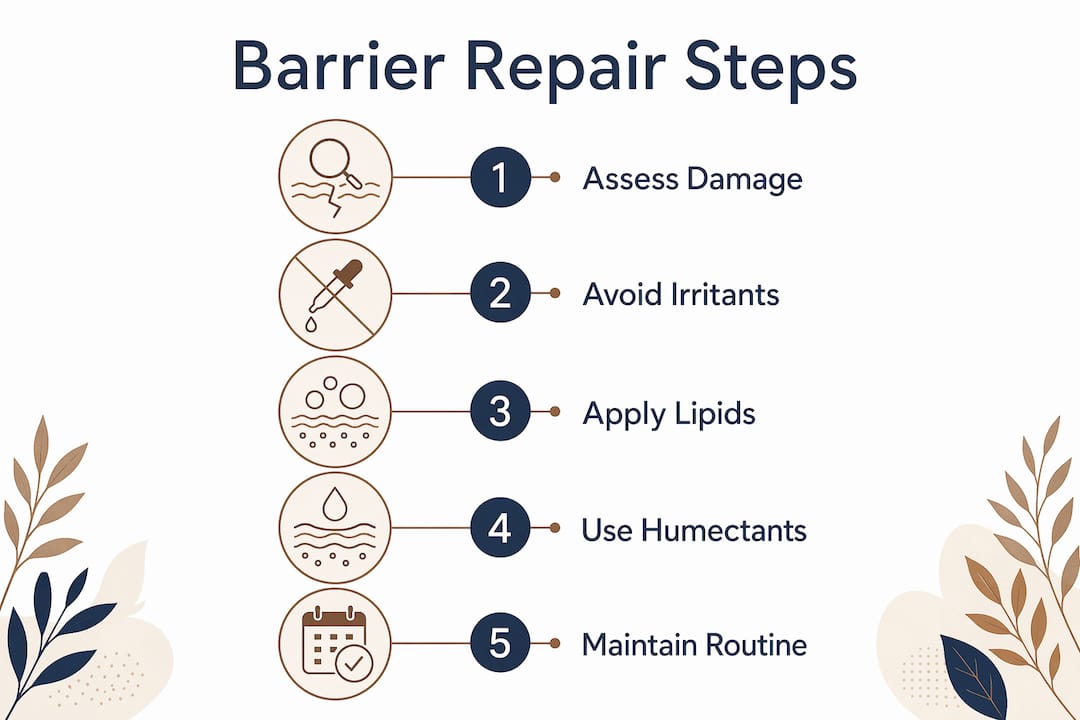
Follow these steps consistently:
- Cleanse gently. Use a sulfate-free, fragrance-free cleanser with lukewarm water. Rinse thoroughly and pat dry with a clean towel. Never rub.
- Apply a humectant. While skin is still slightly damp, apply a hyaluronic acid or glycerin serum to draw moisture in.
- Seal with a ceramide moisturizer. Choose a formula with the 3:1:1 lipid ratio. This locks in the humectant and begins rebuilding the lipid matrix.
- Apply mineral sunscreen in the morning. UV exposure degrades the barrier daily. Skipping sunscreen undoes repair work.
Effective repair routines cap out at 3 to 4 products. Every additional product adds potential irritants and complicates your skin’s response.
Pro Tip: Pause retinoids, AHAs, BHAs, and vitamin C for 2 to 4 weeks during active barrier repair. These actives accelerate cell turnover, which sounds beneficial but disrupts the recovery process when the barrier is already compromised.
Consistency matters more than perfection. Missing one day will not set you back. Switching products every two weeks will. Your skin needs time to respond, and that means committing to the same routine without interruption.
How barrier support reduces sensitivity over time
Barrier repair produces measurable, physiological changes. As the lipid matrix rebuilds, TEWL decreases. Less water escaping means skin stays hydrated without constant reapplication of moisturizer. Inflammation drops because irritants can no longer penetrate as easily.
Barrier repair typically requires 4 to 8 weeks of consistent daily use of targeted products. Most people notice initial comfort within days, visible surface improvement within one week, and structural recovery over the full 4 to 8 week period. Expecting overnight results leads to product switching, which restarts the clock every time.
The practical outcome of a repaired barrier is increased tolerance. Products that once caused stinging or redness become tolerable. Environmental triggers like wind, cold air, and pollution produce less reaction. This is not your skin becoming tougher. It is your skin functioning the way it was designed to.
Sensitive skin that is properly supported often stops being “sensitive skin” entirely. The distinction between true genetic sensitivity and transient reactivity from barrier damage is significant. Most people with reactive skin fall into the second category, which means full recovery is realistic.
For practical steps on calming skin during the repair phase, the Cellure guide on soothing irritated skin covers gentle, proven methods that work alongside a barrier repair routine.
Key Takeaways
Sensitive skin needs barrier support because a compromised stratum corneum drives moisture loss, irritant penetration, and chronic reactivity that targeted lipid repair can reverse within 4 to 8 weeks.
| Point | Details |
|---|---|
| Barrier dysfunction causes sensitivity | A damaged lipid matrix allows water loss and irritant entry, triggering redness and reactivity. |
| Ceramides are the foundation | Products with a 3:1:1 ceramide, cholesterol, and fatty acid ratio rebuild the barrier most effectively. |
| Simplicity speeds recovery | Limit your routine to 3 to 4 products and pause strong actives during the repair phase. |
| Sensitivity is often reversible | Most reactive skin reflects cumulative barrier damage, not permanent genetic sensitivity. |
| Consistency is the active ingredient | Structural barrier recovery takes 4 to 8 weeks of daily, unchanged routine use. |
What I’ve learned from watching sensitive skin recover
Sara here. After years of following dermatological research and watching people work through barrier repair, the pattern I see most often is this: people give up two weeks before their skin would have turned around.
The pressure to see results fast leads to product switching, which is the single most counterproductive thing you can do during barrier repair. Every new product resets the clock and introduces new variables. The skin cannot build a stable lipid matrix if the inputs keep changing.
The second thing I have come to believe strongly is that sensitivity is almost never a life sentence. Sensitivity often reflects cumulative stress and poor skincare sequencing, not a fixed skin type. I have seen people who identified as “extremely sensitive” for a decade achieve calm, tolerant skin within two months of a properly structured routine.
The third lesson is harder to accept: more products are not better. Even gentle products layered on top of each other can overwhelm a recovering barrier. Three well-chosen products, applied consistently, outperform ten products applied inconsistently every time. Listen to your skin. If it stings after a new addition, remove that product. Simple is not a compromise. Simple is the strategy.
— Sara
Cellure’s approach to barrier repair for sensitive skin
Sensitive skin needs a routine built on the right ingredients in the right amounts, not a cabinet full of products.
Cellure’s Complete Skin Repair Kit is formulated with clinically supported bioactive ingredients, including peptides and barrier-restoring actives, designed to work within a simple 3 to 4 step routine. The kit is gentle enough for reactive skin and structured to support the kind of consistent, daily use that barrier recovery actually requires. If you are ready to move from managing sensitivity to addressing its root cause, the Complete Skin Repair Kit gives you a clear, science-backed starting point.
FAQ
What does the skin barrier actually do?
The skin barrier, or stratum corneum, regulates moisture retention and blocks irritants, allergens, and pathogens from entering the skin. When it is intact, skin stays hydrated and calm. When it is damaged, sensitivity and dryness follow.
How long does barrier repair take?
Barrier repair takes 4 to 8 weeks of consistent daily use of targeted products. Initial comfort often appears within days, but structural recovery of the lipid matrix requires the full timeframe.
Can sensitive skin become less reactive permanently?
Yes. Sensitivity is often a temporary state caused by cumulative barrier damage, not a fixed skin type. With targeted barrier support and a simplified routine, most reactive skin can recover to a stable, tolerant baseline.
Which ingredients are best for barrier repair?
Ceramides in a 3:1:1 ratio with cholesterol and fatty acids are the most effective barrier-rebuilding ingredients. Humectants like hyaluronic acid and glycerin support hydration, while niacinamide boosts ceramide synthesis from within.
Should I stop using actives if my skin is sensitive?
Pause retinoids, AHAs, BHAs, and vitamin C for 2 to 4 weeks during active barrier repair. These ingredients accelerate cell turnover and interfere with the recovery process when the barrier is already compromised.