


Why Bioactive Ingredients Matter for Skin Rejuvenation
TL;DR:
- Bioactive ingredients directly target skin aging pathways, producing measurable cellular changes. Delivery techniques like nanocarriers improve their effectiveness by enhancing stability and penetration into the skin. Products backed by independent trials with clear targets and proper concentrations are more likely to deliver real anti-aging benefits.
Bioactive ingredients are molecules that actively modulate biological processes in the skin, going well beyond basic hydration or nutrition. They target specific aging pathways, including oxidative stress, chronic inflammation, and collagen breakdown, to produce measurable changes at the cellular level. That distinction is why bioactive ingredients matter so much in modern skincare. A peptide does not just sit on the surface. It signals fibroblasts to produce collagen. Tranexamic acid interrupts melanin synthesis at the enzymatic level. Polynucleotides stimulate tissue repair by activating growth factor receptors. These are not cosmetic claims. They are documented biological mechanisms, and Cellure builds its entire product philosophy around them.
How do bioactive ingredients work at the cellular level?
Bioactive compounds, the recognized scientific term for this class of molecules, modulate biological processes linked to skin aging through specific molecular and cellular targets. Their effects depend on compound structure, the formulation matrix they are delivered in, and individual host factors like skin microbiome and barrier integrity. That variability is why two products listing the same ingredient can produce very different results.
The core mechanisms fall into three categories:
- Oxidative stress reduction. Antioxidant bioactives like vitamin C and resveratrol neutralize free radicals generated by UV exposure and pollution. Free radical damage accelerates collagen fragmentation and triggers inflammatory cascades that thin the skin over time.
- Peptide signaling. Short-chain peptides act as messenger molecules. Matrikines, for example, are collagen-derived peptides that signal fibroblasts to synthesize new extracellular matrix proteins. The result is firmer, denser skin with improved structural integrity.
- Anti-inflammatory modulation. Bioactives like niacinamide and beta-glucan suppress pro-inflammatory cytokines such as IL-6 and TNF-alpha. Chronic low-grade inflammation, sometimes called “inflammaging,” is one of the primary drivers of visible skin aging.
The impact of bioactive ingredients is not uniform. Oral peptides, for instance, reach systemic circulation and can influence skin from within, while topical peptides act more locally on barrier function and surface hydration. Route of delivery shapes the outcome as much as the ingredient itself.
Pro Tip: When reading a product’s mechanism claims, look for the specific molecular target, not just a category like “antioxidant.” A product that names its target pathway, such as NF-kB inhibition or MMP suppression, is more likely to be backed by real science.

What challenges affect bioactive delivery and effectiveness?
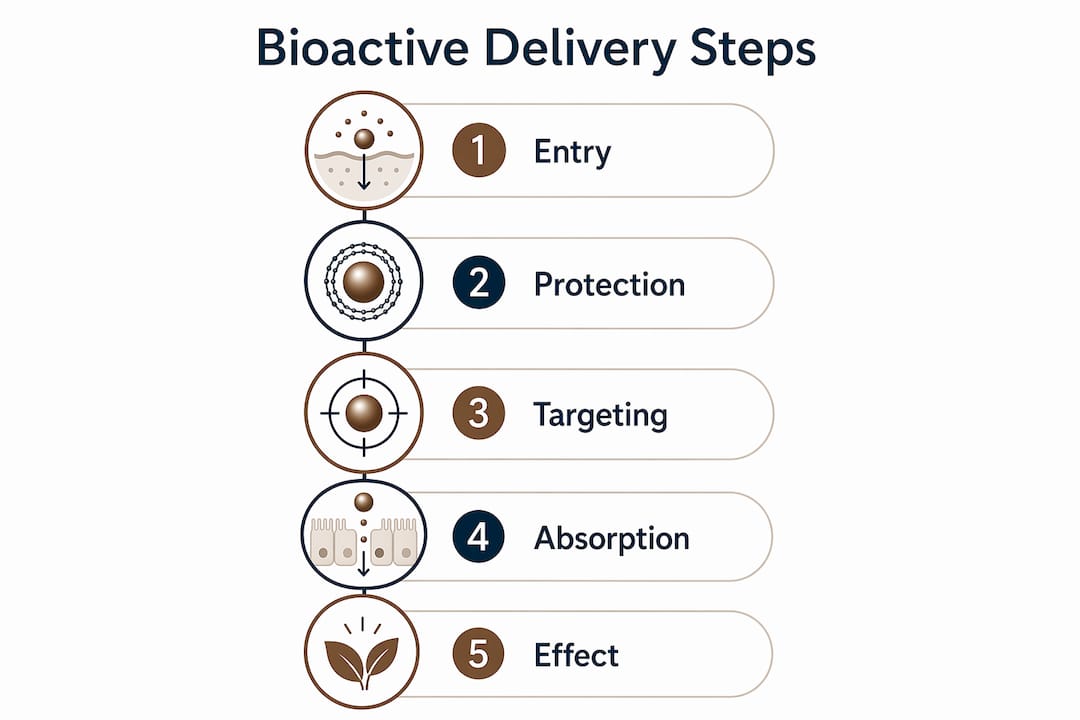
Delivery is the most underappreciated factor in bioactive skincare. Poor bioavailability explains why many topical and systemic products fail to produce the clinical results their ingredient lists promise. The skin barrier, which is the stratum corneum, is designed to keep things out. Most bioactive molecules are either too large, too hydrophilic, or too unstable to cross it at meaningful concentrations.
The main delivery barriers include:
- Molecular size. Larger peptides and polysaccharides cannot penetrate the stratum corneum without a carrier system.
- Chemical instability. Many bioactives degrade rapidly when exposed to light, air, or pH shifts outside a narrow range. Vitamin C oxidizes quickly in water-based formulas. Retinol breaks down under UV exposure.
- Hydrolysis and oxidation. Active compounds can lose their biological function before they ever reach the target skin layer.
“Many molecules with antioxidant or signaling activity in vitro fail to reach viable skin layers at meaningful concentrations due to degradation and skin permeation limits.” — Nanotechnology-Driven Approaches to Bioactive Compound Delivery
Nanotechnology and encapsulation address these problems directly. Nanocarriers protect unstable molecules from environmental degradation, control their release rate, and improve penetration through the skin barrier. Liposomes, polymeric nanoparticles, and solid lipid nanoparticles are the most studied formats. Each creates a protective shell around the active molecule and releases it at the target depth.
Pro Tip: Check whether a product specifies its delivery technology. Terms like “encapsulated,” “liposomal,” or “nano-emulsion” signal that the brand has addressed the stability and penetration problem, not just listed an impressive ingredient.
Which bioactive ingredients have clinically proven anti-aging benefits?
Clinical evidence separates effective bioactives from marketing noise. The strongest data currently supports peptides, collagen hydrolysates, and biomimetic collagen tripeptides, each with documented effects on specific aging parameters.
Peptides: wrinkles, hydration, and brightness
A 2026 meta-analysis of 19 randomized controlled trials found that peptide-based bioactives modestly reduce wrinkles and improve hydration and brightness with minimal adverse effects. Oral polypeptides showed stronger wrinkle reduction than topical formulations. Elasticity improvements were less consistent across trials. That finding matters because it tells you exactly where to set your expectations: peptides reliably improve surface parameters like brightness and moisture retention, but deeper structural changes take longer and depend heavily on dose and delivery format.
Oral collagen peptides: systemic remodeling
In a 12-week randomized controlled trial, oral collagen peptides at 10 g/day significantly reduced wrinkle count and length, increased skin elasticity and hydration, and elevated the systemic aging biomarker Klotho. Higher dose groups showed stronger effects. That dose-response relationship is a hallmark of genuine biological activity, not placebo.
Biomimetic collagen tripeptide: barrier repair
A 4-week clinical study using a 0.1% biomimetic collagen tripeptide serum showed a hydration increase of +72.5%, dryness reduction of up to 93.7%, and improved barrier function with no adverse effects. The study also reported improvements in softness and texture. Those numbers came from objective measurements including transepidermal water loss and standardized imaging, not self-reported surveys.
| Bioactive | Route | Primary benefit | Evidence level |
|---|---|---|---|
| Oral collagen peptides (10 g/day) | Systemic | Wrinkle reduction, elasticity, Klotho elevation | 12-week RCT |
| Topical peptides | Topical | Hydration, brightness, barrier support | Meta-analysis of 19 RCTs |
| Biomimetic collagen tripeptide (0.1%) | Topical | Hydration (+72.5%), barrier repair | 4-week clinical study |
| Tranexamic acid | Topical | Melanin suppression, brightening | Multiple clinical trials |
| Polynucleotides | Topical | Tissue repair, growth factor activation | Emerging clinical data |
You can explore proven bioactive options for aging skin in more detail, including how specific formulations compare on these clinical parameters.
How can you identify effective bioactive skincare products?
Most bioactive marketing claims are not backed by the same quality of evidence as the studies above. Evidence for many bioactive categories is often inconclusive or limited by small-scale, short-duration, industry-sponsored studies. Knowing how to read past the label is a practical skill.
Look for these signals of genuine efficacy:
- Named molecular targets. A product that specifies its mechanism, such as MMP-1 inhibition or collagen type I synthesis stimulation, is more credible than one that claims to “fight aging.”
- Independent clinical evidence. Industry-funded studies are not worthless, but independent or peer-reviewed trials carry more weight. Check whether the cited study used objective endpoints like transepidermal water loss or elasticity measurements.
- Delivery technology disclosure. If a brand uses encapsulation or nanocarriers, it should say so explicitly. Vague terms like “advanced formula” mean nothing.
- Dose transparency. Effective concentrations matter. A product listing retinol at 0.025% will not produce the same results as one at 0.3%.
Avoid products that list bioactives far down the ingredient list, after preservatives and fragrance. Ingredient lists are ordered by concentration. If your key bioactive appears in the bottom third, its concentration is likely too low to produce a clinical effect.
Pro Tip: Search for the ingredient name plus “randomized controlled trial” or “clinical study” in Google Scholar before buying. If no independent human trials exist, the ingredient is still in the experimental phase regardless of what the label says.
What does the future of bioactive skincare look like?
The next generation of bioactive skincare is moving toward personalization and precision delivery. Advances in biosensor technology now allow real-time measurement of skin hydration, barrier function, and inflammatory markers, creating the possibility of formulations adjusted to individual skin biology rather than population averages.
| Emerging area | Current status | Potential impact |
|---|---|---|
| AI-driven formulation | Early commercial stage | Matches bioactive combinations to individual skin profiles |
| Biosensor-integrated skincare | Research and pilot stage | Real-time skin monitoring to guide product use |
| Microbiome-targeted bioactives | Active clinical research | Modulates skin microbiome to reduce inflammaging |
| Personalized oral bioactives | Early development | Dose and compound selection based on genetic markers |
The science of cellular rejuvenation is also expanding beyond peptides and antioxidants. Polynucleotides, exosomes, and growth factor analogs are entering clinical trials with promising early results. The critical gap remains the same as it has always been: most innovations need larger, longer, independent trials before they can be recommended with confidence.
Key takeaways
Bioactive compounds work through specific molecular targets, and delivery quality determines whether those targets are actually reached in the skin.
| Point | Details |
|---|---|
| Mechanism specificity matters | Effective bioactives target named pathways like collagen synthesis or oxidative stress, not vague “anti-aging” effects. |
| Delivery determines outcomes | Encapsulation and nanocarrier technology are required for many bioactives to reach viable skin layers at effective concentrations. |
| Oral and topical routes differ | Oral peptides produce stronger systemic wrinkle benefits; topical peptides excel at hydration and barrier support. |
| Clinical evidence varies widely | Look for independent RCTs with objective endpoints, not brand-funded studies with self-reported results. |
| Dose and concentration are non-negotiable | An ingredient listed at the bottom of a formula will not produce the same results as one at a clinically validated concentration. |
What I have learned from years of watching bioactive trends
The bioactive skincare category has a credibility problem that the best brands are only beginning to solve. For every well-formulated peptide serum backed by a genuine randomized controlled trial, there are dozens of products that list the same ingredient at a concentration too low to do anything measurable. I have watched this pattern repeat across retinol, niacinamide, hyaluronic acid, and now polynucleotides. The ingredient becomes a buzzword before the clinical evidence catches up.
What I find genuinely encouraging is the shift toward objective measurement. Studies that use transepidermal water loss meters, cutometer elasticity readings, and standardized wrinkle imaging are replacing self-reported “skin feels softer” surveys. That shift forces brands to either prove their claims or stop making them. The science behind bioactive skincare is real and growing. The problem has never been the biology. It has been the gap between what a molecule does in a lab and what a product delivers to your skin.
My honest advice: treat your skincare budget like a small clinical trial. Pick one product with a named mechanism, a disclosed concentration, and at least one independent study. Use it consistently for 12 weeks. Measure the result with a before-and-after photo taken in identical lighting. That discipline will teach you more about what works for your skin than any ingredient trend ever will.
— Sara
Cellure’s Complete Skin Repair Kit: bioactives that reach the target
Cellure formulates with the delivery problem already solved. The Complete Skin Repair Kit combines peptides, tranexamic acid, and polynucleotides in formulations designed for cellular-level penetration, not just surface application. Each ingredient is selected for its documented mechanism and included at a concentration that matches clinical study parameters. The kit addresses firmness loss, uneven tone, and barrier damage in a single, coordinated protocol. If you want to apply what this article covers to an actual skincare routine, the Complete Skin Repair Kit is where Cellure’s science translates into daily practice.
FAQ
What are bioactive ingredients in skincare?
Bioactive ingredients are molecules that modulate specific biological processes in the skin, such as collagen synthesis, oxidative stress reduction, or inflammation control. They differ from basic cosmetic ingredients because they produce measurable changes at the cellular level.
How do bioactive compounds improve aging skin?
Bioactive compounds target aging pathways directly. Peptides signal fibroblasts to produce collagen, antioxidants neutralize free radicals, and anti-inflammatory bioactives suppress cytokines that drive skin thinning over time.
Why does delivery technology matter for bioactive skincare?
Many bioactives degrade before reaching viable skin layers or cannot cross the stratum corneum without a carrier. Encapsulation and nanocarrier systems protect the molecule and improve penetration, which is why delivery and formulation determine whether a bioactive actually works in practice.
Are oral bioactives more effective than topical ones?
For wrinkle reduction, oral collagen peptides at 10 g/day showed stronger systemic effects in a 12-week RCT than topical peptides. Topical peptides perform more reliably for hydration and brightness. The best approach depends on the specific outcome you are targeting.
How do I know if a bioactive skincare product is worth buying?
Look for products that name their molecular target, disclose the concentration of key actives, use a recognized delivery technology, and cite at least one independent clinical trial with objective endpoints. Avoid products where the key bioactive appears near the bottom of the ingredient list.