


What Is Comprehensive Repair for Your Skin?
TL;DR:
- Comprehensive skin repair is a structured, science-based process that restores barrier function and cellular health for lasting improvements in texture, tone, and firmness. It involves careful sequencing of products and treatments, with emphasis on barrier support, gradual reintroduction of actives, and consistency over time. Rushing or using isolated products without a coordinated system often hinders true progress and can cause further damage.
Most people assume comprehensive repair means buying more products and applying them more often. That assumption is the reason so many people spend years cycling through expensive serums without seeing real change. What is comprehensive repair, exactly? It’s a structured, science-backed process that restores your skin from the barrier level down to the cellular foundation, addressing the root causes of aging, dullness, and weakened texture rather than masking symptoms. This article covers what the process actually involves, how long it takes, and what separates it from the piecemeal approaches most of us start with.
Table of Contents
- Key Takeaways
- What comprehensive repair actually means for skin
- Core components of a full repair program
- The phases and timeline you should realistically expect
- Comprehensive repair vs partial approaches
- My take on why so many people miss the point
- How Cellure supports genuine skin repair
- FAQ
Key Takeaways
| Point | Details |
|---|---|
| It starts at the barrier | Comprehensive repair begins with restoring barrier function before introducing any active treatments. |
| Sequencing is everything | The order in which you apply products and treatments directly impacts how well your skin responds and recovers. |
| Stopping is a step | Removing harmful or mismatched products is as important as adding the right ones. |
| Consistency beats complexity | A simple, well-maintained routine outperforms an elaborate one applied inconsistently. |
| Cells need time | Visible results from genuine skin repair take weeks to months, not days. |
What comprehensive repair actually means for skin
The comprehensive repair definition, as it applies to skin, goes beyond topical coverage. It refers to a process that improves skin quality structurally and cellularly, producing lasting improvements in texture, tone, firmness, and luminosity rather than temporary surface effects. You are not just hydrating dry patches or fading one dark spot. You are restoring the biological conditions that allow your skin to function, protect itself, and renew itself correctly.
Your skin operates on three interconnected levels: the outer barrier, the dermis beneath it, and the cellular activity happening throughout. The barrier, built from a “brick and mortar” structure of corneocytes held together by a lipid matrix, is your first line of defense against moisture loss, irritants, and environmental damage. When it breaks down, everything downstream suffers. Inflammation rises, healing slows, and active ingredients applied on top of a compromised barrier either irritate the skin or simply fail to absorb.
The dermis holds collagen, elastin, and the support structures responsible for firmness and elasticity. Below and around that, fat pads and fascia contribute to facial volume and contour. Comprehensive repair acknowledges all of these layers rather than treating just one. Rehabilitating compromised skin before rejuvenation therapies restores barrier integrity, healing capacity, and inflammatory balance, which means your skin can actually respond when you do apply actives or professional treatments.
Pro Tip: If your skin regularly stings, reddens, or flares after applying products that should be gentle, your barrier is likely compromised. No active ingredient will work well until that is resolved first.
Core components of a full repair program
What does comprehensive repair include in practice? It involves a coordinated set of products, habits, and treatments working toward the same goal at different depths. No single serum or procedure can do this alone.
At the product level, the foundation includes:
- Gentle cleanser: Removes debris without stripping the lipid matrix that holds barrier cells together.
- Barrier-supportive moisturizer: Formulated with ceramides, fatty acids, and humectants like hyaluronic acid to reinforce the mortar layer and retain moisture.
- Targeted actives: Peptides to signal collagen production, tranexamic acid for tone correction, and polynucleotides for cellular regeneration, each introduced strategically.
- Broad-spectrum sunscreen: Reduces visible signs of aging by up to 24% over 4.5 years, making it a non-negotiable component of any genuine repair routine.
Coordinated product systems optimize absorption and preserve barrier integrity. When products are chosen independently without considering how they interact, the result is often counterproductive. Layering a strong retinol over a barrier in recovery, for example, extends the damage rather than addressing it.
Professional treatments can accelerate results significantly when the skin is ready to receive them. Laser skin tightening, particularly CO2 and fractional lasers, stimulates collagen remodeling and improves texture, tone, and firmness through controlled wound-healing responses. Microneedling, radiofrequency, and chemical peels each work at different depths and serve different purposes. What distinguishes comprehensive repair services from isolated procedures is the deliberate combination of these tools, sequenced and spaced to support each other rather than compete.
Understanding cellular rejuvenation versus surface treatments is part of making informed choices about which elements belong in your personal repair program.
The phases and timeline you should realistically expect
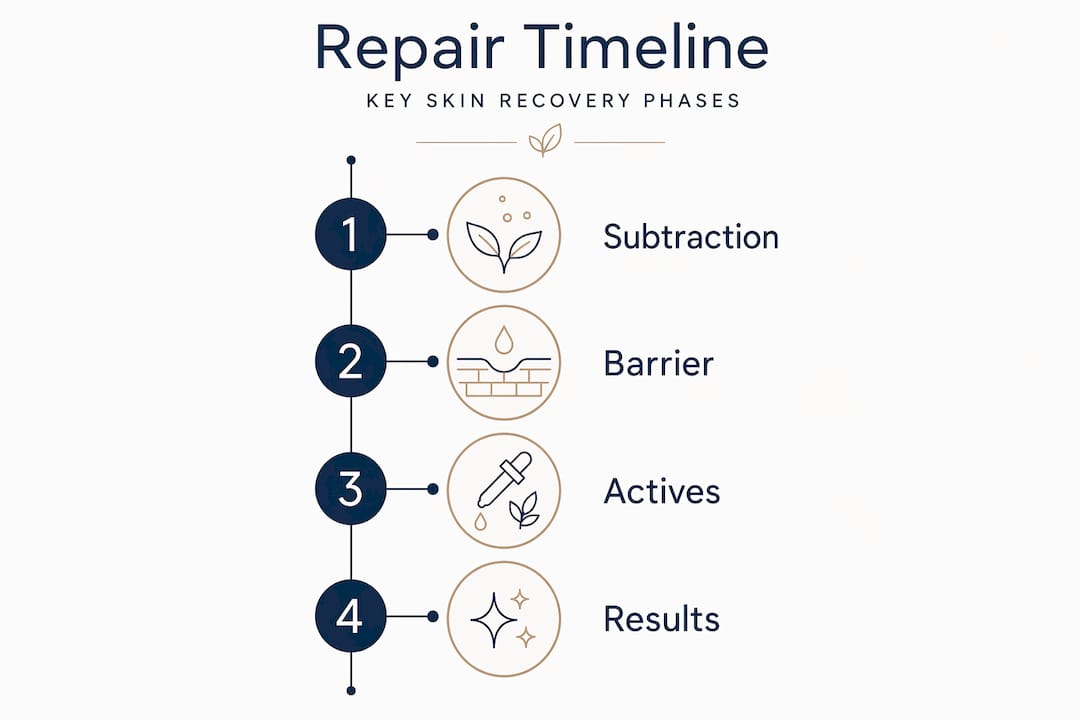
Comprehensive repair does not happen in a weekend. It unfolds in phases, each one building on the one before it. Trying to rush the sequence is one of the most common reasons results disappoint.
- Stop what’s hurting you. The subtraction phase requires discontinuing exfoliating actives for 14 days, including retinol, AHAs, and BHAs. This is often the hardest step because it feels like going backward. It is not. Removing insults is the fastest way to let repair begin.
- Rebuild the barrier. For two to six weeks, focus exclusively on gentle cleansing, barrier-supportive moisturizer, and sunscreen. Some people notice calmer, more even skin within days. Others need the full six weeks before their skin stops reacting to everything.
- Reintroduce actives gradually. Start with one ingredient at a time. Peptides and niacinamide are well-tolerated early additions. Retinoids and stronger exfoliants come later, at low concentrations, with close attention to skin response.
- Integrate professional treatments. Once the barrier is stable and inflammation is low, in-office treatments work more effectively and carry less risk of complications.
- Maintain with consistency. Consistent routines deliver superior results over complex but irregular ones. The maintenance phase is not passive. It is the period where the most noticeable transformation happens.
Here is a simplified overview of what to expect at each phase:
| Phase | Duration | Primary focus |
|---|---|---|
| Subtraction | 1 to 2 weeks | Stop actives, reduce friction |
| Barrier rebuilding | 2 to 6 weeks | Ceramides, hydration, sunscreen |
| Active reintroduction | 4 to 8 weeks | Peptides, tone correctors, low-dose retinoids |
| Professional treatments | Ongoing | Lasers, microneedling, RF as appropriate |
| Maintenance | Indefinite | Consistent routine, regular reassessment |
Pro Tip: Apply your moisturizer to damp skin within 60 seconds of cleansing. Hydration improves by up to 50% with this single habit, and it costs nothing extra.
Environmental and lifestyle factors influence every phase. Sleep quality affects cellular turnover. Chronic stress elevates cortisol, which degrades collagen and weakens the barrier. Sun exposure without protection undoes months of progress. Comprehensive repair includes these variables, not as optional extras, but as part of the system.
Comprehensive repair vs partial approaches
Most skincare routines are not actually comprehensive. They are collections of individual products chosen for individual concerns, applied in whatever order feels right. This is partial repair at best and counterproductive at worst.
The risks of a fragmented approach are specific and common. Over-exfoliation strips the lipid matrix and inflames the barrier. Mixing incompatible actives (vitamin C with niacinamide at high concentrations, or AHAs with retinol on the same night) neutralizes efficacy and increases irritation. Treating one concern aggressively while ignoring another means the skin never reaches a stable baseline from which real improvement can happen.
Full-face rejuvenation plans that address multiple skin layers simultaneously yield more harmonious and natural results than isolated treatments. The same principle applies to at-home routines. A coordinated system that works on the barrier, dermis, and cellular level at the same time produces results that feel genuinely different from piecemeal skincare.
Here is how the two approaches compare:
| Feature | Comprehensive repair | Partial or fragmented approach |
|---|---|---|
| Goal | Structural and cellular restoration | Symptom relief or single-concern improvement |
| Product selection | Coordinated, synergistic | Independent, often mismatched |
| Treatment sequencing | Deliberate phases | Random or reactionary |
| Results | Lasting texture, tone, and firmness | Temporary or inconsistent improvements |
| Risk of irritation | Low when followed correctly | Higher due to product conflicts |
The importance of comprehensive repair becomes obvious when you consider how many people report using 8 to 10 products daily while still feeling like their skin has not improved. The issue is rarely the products themselves. It is the absence of coordination, sequence, and biological foundation. You can learn more about science-backed approaches to cellular repair to see how this plays out in practice.
My take on why so many people miss the point
I have watched people approach skin repair the way they approach a renovation project: start with the cosmetic changes, skip the foundation work, and then wonder why nothing holds. The most common version of this mistake is introducing retinol or a professional laser treatment on skin that is already inflamed and reactive. The skin’s barrier is too compromised to handle it, so the result is irritation and setback rather than progress.
What I have seen consistently is that the clients who get the best outcomes are not the ones using the most products. They are the ones who slowed down, stopped everything for a few weeks, and let their skin stabilize before building back up. That initial subtraction phase feels uncomfortable precisely because it goes against the “do more” instinct that most skincare marketing pushes. But it is often the most impactful thing someone can do.
I also think the word “comprehensive” gets abused in this space. A brand can label anything a comprehensive repair kit. What actually earns that label is a formulation logic where each ingredient supports a specific layer of function, sequenced in a way that makes biological sense. Polynucleotides for cellular signaling, peptides for collagen scaffolding, barrier lipids for structural integrity. When those pieces work together, the results are not subtle.
How to choose comprehensive repair products comes down to one question: does this system have a logic? If you cannot explain why each product is in the routine and in that order, the routine is not comprehensive. It is just a collection.
— Sara
How Cellure supports genuine skin repair
If you are ready to move past piecemeal skincare and work with a system built around actual repair science, Cellure’s approach is worth understanding. The Complete Skin Repair Kit is formulated around the exact logic this article describes: barrier support first, then targeted cellular actives, all in a sequence that makes biological sense. Ingredients like peptides, polynucleotides, and tranexamic acid are not added for label appeal. They are there because each one addresses a specific layer of the repair process. You can also explore Cellure’s full active ingredient philosophy to understand what goes into each formulation and why it earns a place in a genuine repair routine.
FAQ
What is the comprehensive repair definition for skin?
Comprehensive repair is a structured process that restores skin function at the barrier, dermal, and cellular levels, producing lasting improvements in texture, tone, firmness, and hydration rather than temporary symptom relief.
What does comprehensive repair include in a routine?
It includes a gentle cleanser, barrier-rebuilding moisturizer, targeted actives like peptides and tone correctors, daily sunscreen, and optionally professional treatments such as lasers or microneedling, all applied in a deliberate sequence.
How long does comprehensive skin repair take?
The subtraction and barrier-rebuilding phases alone take four to eight weeks. Full visible results from coordinated active treatments and professional procedures typically appear over three to six months of consistent practice.
What is the difference between comprehensive repair vs partial repair?
Partial repair addresses isolated symptoms using mismatched products without a system. Comprehensive repair coordinates products and treatments across multiple skin layers with deliberate sequencing, producing structural changes rather than surface corrections.
How do you choose comprehensive repair products that actually work?
Look for formulations with a clear biological logic, where barrier support, cellular actives, and anti-inflammatory ingredients are present in a sequence that makes sense for your skin’s recovery stage. Avoid kits that list trending ingredients without explaining how they interact.