


Stop Tranexamic Acid Irritation in 1–3 Weeks: A Sensitive Skin Plan
Topical tranexamic acid is one of the gentler skin brighteners you can use, but mild irritation, dryness, or stinging still shows up for some people. If that happens, pause application for a few days, apply a barrier moisturizer, drop any other active ingredients you’re layering underneath it, and patch-test before restarting. Real allergic reactions are rare, but hives, swelling, or blistering mean stop and call a doctor.
TL;DR:
- Using tranexamic acid with strong active ingredients like acids or retinoids increases the risk of irritation and should be introduced gradually.
- Mild side effects such as dryness or redness typically resolve within one to three weeks with proper moisturizer use and reduced application frequency.
- Reactions limited to redness or tightness usually cease within a few days of discontinuation, while allergic reactions involve hives or swelling requiring immediate medical attention.
- To minimize irritation, patch-test before full use, start with every-other-night applications, and avoid layering with other actives during the initial weeks.
- Topical tranexamic acid mostly targets pigmentation without causing peeling or systemic risks, unlike oral or in-office formulations that have different safety profiles.
Table of Contents
- What Causes Sensitivity or Irritation With Topical Tranexamic Acid?
- What Side Effects Are Normal, and How Long Do They Last?
- Mild Irritation or Allergic Reaction: How Can You Tell the Difference?
- How to Prevent and Manage Irritation From Tranexamic Acid
- When Should You Stop Using Tranexamic Acid and See a Doctor?
- How Is Topical Tranexamic Acid Different From Retinoids, Acids, and Oral TXA?
- How Cellure Formulates for Lower Irritation Risk
- Sara’s Take: Effectiveness Doesn’t Have to Cost You Comfort
- Try Cellure’s Tranexamic Acid Peptide Serum
- Where This Guidance Comes From
- Sources
What Causes Sensitivity or Irritation With Topical Tranexamic Acid?
Tranexamic acid itself is not an exfoliant. It doesn’t strip cell layers or accelerate turnover the way glycolic acid or retinol does, so on its own it rarely causes the burning or peeling people associate with “strong” actives, according to Healthline’s overview of tranexamic acid for skin. Most irritation people blame on tranexamic acid actually comes from what it’s sitting next to in the formula, or how it’s being used.
Common triggers include:
- Co-formulated actives. Serums that blend tranexamic acid with AHAs, BHAs, retinoids, kojic acid, or high concentrations of alcohol are far more likely to sting or flake than a straightforward tranexamic acid serum.
- Product pH and vehicle. A high-alcohol gel base behaves very differently on skin than a cream built around ceramides or peptides.
- A compromised barrier. Skin that’s already dry, sunburned, freshly exfoliated, or dealing with eczema will react to almost anything, tranexamic acid included.
- Overuse. Applying twice daily right out of the gate, instead of easing in, invites redness that a slower schedule would have avoided.
- Eye-area contact. Tranexamic acid carries a GHS H319 hazard classification for eye irritation, so getting it near the lash line or under-eye area can cause real stinging, even though the rest of your face tolerates it fine.
What Side Effects Are Normal, and How Long Do They Last?
Mild dryness, light flaking, faint redness, or a brief stinging sensation on application are the most commonly reported effects, and they typically show up within hours to a few days of starting a new product, not weeks later.
By the numbers: Clinical dermatology reviews describe topical tranexamic acid as generally well tolerated, with adverse events concentrated in mild, self-limited categories like erythema and scaling that improve once you moisturize consistently or space out applications, per PMC’s review of tranexamic acid in dermatology.
Most people who dial back frequency and add a supportive moisturizer see meaningful improvement within one to three weeks. That’s a very different picture from what happens with in-office procedures. When tranexamic acid is injected or used alongside microneedling, transient burning and stinging are common procedural side effects, not signs the ingredient itself is harsh, according to a PMC update on tranexamic acid for hyperpigmentation and vascular disorders. Oral tranexamic acid, used for heavy bleeding or melasma in some cases, carries a separate side-effect profile involving systemic circulation, which topical use simply doesn’t touch.
Mild Irritation or Allergic Reaction: How Can You Tell the Difference?
Most reactions to topical tranexamic acid are irritation, not allergy, and the two look different if you know what to check.
- Assess the scope. Mild irritation stays localized to where you applied product, usually just some redness, tightness, or flaking on the cheeks or wherever you patted it in.
- Check whether it settles. True irritation calms down within a day or two of stopping the product and moisturizing; if it’s getting worse instead of better, that’s a signal to escalate.
- Watch for hives, welts, or spreading rash. These point toward a hypersensitivity or allergic reaction rather than simple irritation, and they warrant stopping the product immediately.
- Note swelling, especially near the eyes, lips, or throat. This is not a “wait and see” symptom.
- Photograph the reaction daily. A simple photo log makes it much easier for a dermatologist to assess severity and progression if you do need a consult.
- Track what else touched your skin that week. New sunscreen, a fragrance switch, or a fresh exfoliating pad can all confuse the picture if you don’t write it down.
How to Prevent and Manage Irritation From Tranexamic Acid
You can head off most reactions before they start, and calm the ones that do happen with a straightforward routine.
- Patch-test first. Apply a small amount to your inner forearm or behind the ear and wait 24 to 72 hours, watching for redness, itching, or bumps before you put it anywhere near your face, a step Healthline recommends for any new active.
- Introduce it slowly. Start every other night, move to nightly use after a week if skin looks calm, and only consider twice daily once your skin has clearly adjusted.
- Strip back the rest of your routine while you introduce it. Skip AHAs, BHAs, retinoids, and benzoyl peroxide for the first two to three weeks. Layering tranexamic acid on top of an already-active routine is the single most common reason people report stinging.
- Pair it with calming, supportive ingredients instead. Ceramides, hyaluronic acid, and peptides support the barrier while tranexamic acid does its job, rather than competing with it for tolerance. A gentle, barrier-focused calming routine makes this easier to build.
- If irritation shows up, stop everything nonessential immediately. Cut back to a bland moisturizer, cool compresses if there’s stinging, and skip physical scrubs or exfoliating tools entirely until skin settles.
- Wait for a symptom-free stretch before trying again. Give your skin one to two full weeks with no redness or flaking before reintroducing tranexamic acid, and go back to the every-other-day schedule rather than jumping straight to daily use.
- Keep a simple usage log. Note the date, frequency, and any reaction each time you use it. Patterns that aren’t obvious day-to-day often become clear after two or three weeks logged on paper.
Pro Tip: Read the full ingredient list before blaming tranexamic acid for a bad reaction. In most complaint threads, the actual culprit is a co-active like kojic acid, a high-alcohol base, or fragrance, not the tranexamic acid itself.
When Should You Stop Using Tranexamic Acid and See a Doctor?
Give conservative care a fair chance, but know the limits.
- Stop and consult a dermatologist if irritation lingers past two to three weeks despite reducing frequency and moisturizing consistently, since that’s longer than typical adjustment reactions take to resolve.
- Seek immediate medical care for facial, lip, or tongue swelling, difficulty breathing, or widespread blistering. These are signs of a serious reaction, not routine irritation, and they need urgent attention, not a wait-and-see approach.
- Talk to a clinician before combining topical use with systemic tranexamic acid if you’re pregnant, breastfeeding, or taking anticoagulants. Topical absorption into the bloodstream is low, but oral or injectable tranexamic acid carries genuine contraindications in those situations that topical use doesn’t share, per PMC’s dermatology safety review.
How Is Topical Tranexamic Acid Different From Retinoids, Acids, and Oral TXA?
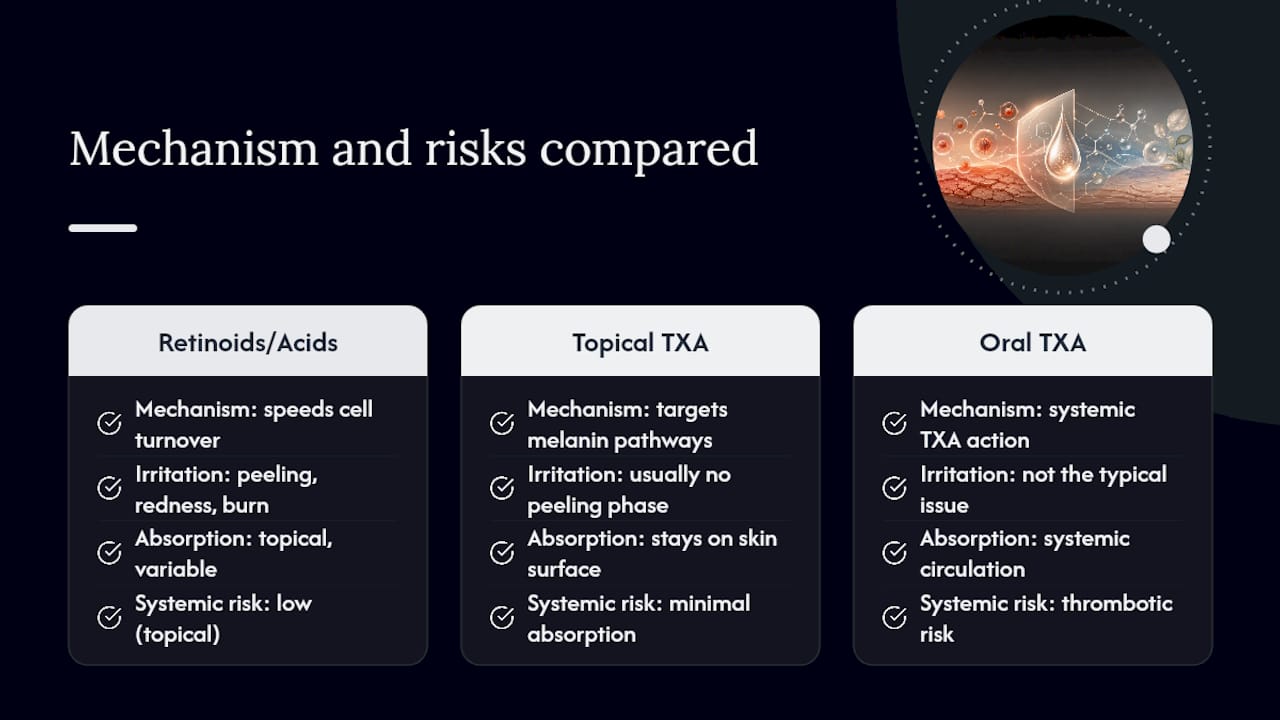
Retinoids and exfoliating acids work by speeding up cell turnover, which is exactly why they cause peeling, redness, and that “retinization” burn during the first few weeks. Tranexamic acid doesn’t operate that way. It targets melanin production pathways rather than shedding skin cells, which is a large part of why it typically skips the peeling phase that products like kojic acid or stronger retinoid regimens often bring with them.
Systemic risk differs just as much. Topical application stays largely on the skin’s surface with minimal absorption into circulation, while oral tranexamic acid carries thrombotic risk and distinct contraindications that simply don’t apply to a serum. The main reason people report irritation from topical tranexamic acid almost always traces back to what else is in the bottle, or what else is in their routine, rather than tranexamic acid acting alone.
How Cellure Formulates for Lower Irritation Risk
Pairing tranexamic acid with peptides and barrier-supporting ingredients changes how skin tolerates it, compared with a bare-bones acid serum built on a high-alcohol base. Peptides support the skin’s structural proteins while tranexamic acid works on pigmentation, and that combination tends to sit more comfortably on reactive skin than a stripped-down formula does.
A workable regimen looks like this: patch-test on your inner arm for 48 hours, introduce every other night for a week, then pair it with a barrier-repair moisturizer rather than another active. Cellure’s approach to aging skin builds around that same low-and-slow logic, and formulation choices like vehicle and added ceramides materially change how well skin tolerates the ingredient over time.
Sara’s Take: Effectiveness Doesn’t Have to Cost You Comfort

The instinct with any new active is to go all in, apply it twice a day, stack it with three other serums, and hope for faster results. With tranexamic acid, that instinct works against you. It’s one of the more forgiving brightening ingredients on the market precisely because it isn’t chasing exfoliation, and treating it like a harsh acid by overloading your routine is how people manufacture irritation that wouldn’t otherwise happen.
My honest advice: go slower than you think you need to, especially if you have rosacea, an already compromised barrier, or a complicated medication history. If you’re pregnant, breastfeeding, or managing a condition involving blood clotting, loop in a dermatologist before adding any tranexamic acid product, topical or otherwise. Slow introduction isn’t a sign the ingredient is weak. It’s how you get the pigment-fading benefit without the two weeks of redness that impatience causes.
— Sara
Try Cellure’s Tranexamic Acid Peptide Serum
If you want the pigment-fading benefit of tranexamic acid without gambling on a formula loaded with alcohol or competing acids, Cellure built its Tranexamic Acid Peptide Serum around a low-irritant base specifically for skin that reacts easily.

The formula pairs tranexamic acid with peptides and barrier-supporting ingredients instead of stacking it with exfoliating acids, so there’s nothing else in the bottle fighting your skin while it adjusts. It comes with clear instructions for easing in gradually, which matters more than most brightening products admit. If your skin has reacted to depigmenting serums before, or you’re simply starting cautiously, patch-test the serum on your inner arm, then work it into your routine every other night for the first week. Visit Cellure to check the full ingredient breakdown and get started.
Where This Guidance Comes From
The clinical claims here draw on PMC’s review of tranexamic acid in dermatology, which covers topical tolerability and the systemic risk gap between topical and oral use, along with a PMC update on tranexamic acid for hyperpigmentation and vascular disorders covering procedural side effects. Patient-facing guidance on patch testing and common triggers comes from Healthline, and eye-safety classification details come from SkinSenseDiary. For formulation background, see Cellure’s guide on tranexamic acid and aging skin.
This article is general information, not a substitute for advice from a qualified doctor. Consult a qualified healthcare professional about your own circumstances before acting on anything here.
Sources
- THE USE OF TRANEXAMIC ACID IN DERMATOLOGY - PMC
- Tranexamic Acid for Skin: Benefits, Safety, How to Use
- Tranexamic Acid: Is It Safe? Benefits, Side Effects & How to Use | SkinSenseDiary