


The Role of Copper Peptides in Skin Repair and Aging
TL;DR:
- Copper peptides support skin repair by stimulating collagen, elastin, and tissue remodeling, especially as levels decline with age. They work best with proper delivery methods like microneedling or liposomal formulations and require consistent use over several weeks to show modest but meaningful results. These multifunctional molecules complement stronger actives such as retinoids and vitamin C, enhancing overall skin health and resilience.
Copper peptides are bioactive molecules that bind copper ions and regulate the skin’s natural repair processes, making them one of the most studied ingredients in anti-aging skincare. The role of copper peptides in skin health centers on their ability to stimulate collagen and elastin production, reduce inflammation, and support tissue remodeling at the cellular level. The most researched form, GHK-Cu (glycyl-L-histidyl-L-lysine copper), occurs naturally in human plasma and skin but declines with age, leaving skin less able to repair itself. Understanding how these molecules work gives you a real foundation for choosing skincare that delivers lasting results rather than temporary surface effects.
What is the role of copper peptides in skin biology?
GHK-Cu is an endogenous signaling molecule, meaning your body produces it naturally to coordinate wound healing and tissue repair. When levels drop with age, the skin loses a key biological signal that tells fibroblasts to get to work. Copper peptides stimulate fibroblasts to produce collagen and elastin, reduce oxidative stress, and support the structural matrix that keeps skin firm and resilient. That makes them fundamentally different from surface-level moisturizers or temporary plumping agents.

The biological activity of GHK-Cu extends well beyond collagen synthesis. It coordinates angiogenesis (new blood vessel formation), recruits immune cells to repair sites, and drives matrix remodeling, the process by which old, damaged tissue is replaced with new, organized structure. GHK-Cu upregulates TGF-beta1 signaling in fibroblasts, which increases the expression of collagen I, collagen III, and elastin at the gene level. This is not a cosmetic trick. It is a cellular instruction.
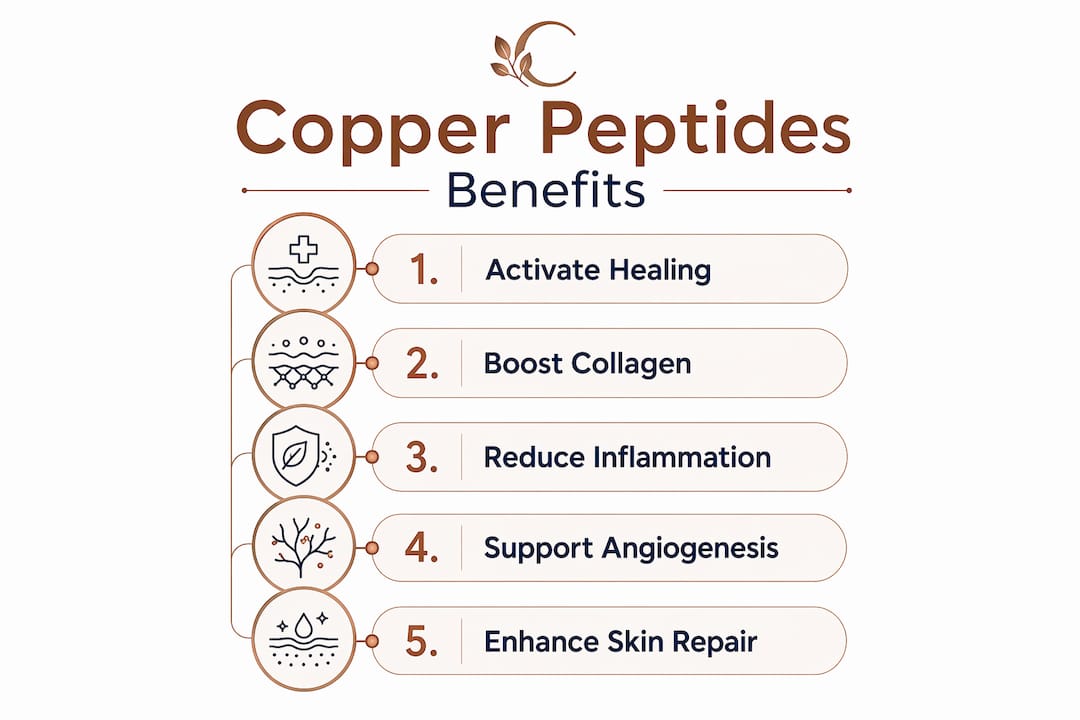
Copper peptides also function as carrier peptides, delivering ionic copper directly to enzymes like lysyl oxidase that need it to cross-link collagen fibers. Without adequate copper, newly synthesized collagen cannot form the tight, organized networks that give skin its firmness. This dual role, both signaling and mineral delivery, is what sets copper peptides apart from single-mechanism actives. You can read more about how peptide technology supports repair at the cellular level.
Skin barrier penetration: the real challenge
One significant limitation is that GHK-Cu is hydrophilic, meaning it does not cross intact skin efficiently on its own. Microneedling dramatically increases delivery: microneedle pretreatment enabled 134 nanomoles of GHK peptide to cross human skin in 9 hours, compared to nearly zero without it. That number matters because it shows that formulation and delivery method are not secondary concerns. They determine whether the active ingredient actually reaches the fibroblasts it needs to reach.
- Liposomal encapsulation improves penetration in leave-on serums
- Microneedling or dermaroller pretreatment creates temporary channels for deeper delivery
- Lower-pH formulations can improve stability of the copper complex
- Applying copper peptide serums to slightly damp skin may support absorption
Pro Tip: If you use a dermaroller at home, apply your copper peptide serum immediately after rolling while channels are still open. This is when absorption is highest.
What does clinical evidence say about copper peptides?
The clinical record on topical copper peptides is promising but measured. A 2018 controlled study with 67 women applying GHK-Cu over 12 weeks showed statistically significant improvements in fine line depth, skin laxity, and collagen production in approximately 70% of participants. That is a meaningful result. It also reflects the reality that copper peptides produce genuine but modest improvements, not dramatic overnight transformations.
Timing matters as much as the ingredient itself. Professionals report that skin healing and quality improvements typically become noticeable within 1 to 2 months of consistent use, with structural changes in firmness appearing over 4 to 8 weeks. Texture and tone often improve first, followed by gradual increases in firmness. Expecting visible lifting within a week sets you up for disappointment.
| Outcome measured | Typical timeframe | Evidence strength |
|---|---|---|
| Skin texture and tone | 4–6 weeks | Moderate (multiple small trials) |
| Fine line depth reduction | 8–12 weeks | Moderate (2018 RCT, 67 participants) |
| Skin laxity improvement | 8–12 weeks | Moderate |
| Collagen density increase | 12+ weeks | Moderate to strong (cell culture + clinical) |
| Wound healing support | 1–2 weeks | Strong (clinical and in vivo data) |
Current studies share common limitations: small sample sizes, short durations, and frequent industry funding. The honest read is that copper peptides work, but the effect size is modest compared to prescription-strength retinoids. That does not make them less valuable. It means you need to use them correctly and consistently to see results.
How do copper peptides compare to other anti-aging actives?
Copper peptides are not wrinkle erasers. They are skin repair and regeneration boosters, and that distinction changes how you should use them. Retinoids accelerate cell turnover and produce faster visible results, but they also cause irritation, peeling, and photosensitivity, especially in the early weeks of use. Copper peptides complement stronger actives by supporting recovery, reducing inflammation, and reinforcing the skin barrier that retinoids can temporarily compromise.
Vitamin C is a potent antioxidant that brightens skin and supports collagen synthesis through a different pathway than copper peptides. The two can work together, though some formulators caution against combining them in the same application step due to potential oxidation of the copper complex. Using vitamin C in the morning and copper peptides at night sidesteps this issue entirely.
Here is how copper peptides differ from the most common anti-aging actives:
- Retinoids: Faster visible results, higher irritation risk. Copper peptides support recovery when used alongside retinoids.
- Vitamin C: Antioxidant and brightening focus. Different collagen pathway. Best used at separate times of day.
- Niacinamide: Barrier support and tone evening. Low irritation. Pairs well with copper peptides.
- Hyaluronic acid: Hydration only, no structural repair. Copper peptides address what hyaluronic acid cannot.
- Copper peptides: Multifunctional repair, anti-inflammatory, antioxidant, and collagen stimulating. Slower results, high tolerability.
The unique multifunctional role of peptides in skin aging makes them worth including even when you already use retinoids or vitamin C. Think of copper peptides as the foundation that makes other actives work better and last longer.
How do you use copper peptides in a skincare routine?
Building copper peptides into your routine effectively comes down to consistency, sequencing, and realistic expectations. Start with every other day application if your skin is new to active ingredients, then move to daily use once your skin adjusts. Most people see the best results from a nightly routine where copper peptides are applied after cleansing and before a moisturizer.
- Cleanse with a gentle, pH-balanced cleanser to remove barriers to absorption.
- Apply copper peptide serum to slightly damp skin, pressing it in rather than rubbing.
- Follow with moisturizer to seal in the serum and support the skin barrier.
- Use sunscreen every morning because copper peptides support repair but do not protect against UV damage.
- Be consistent for at least 8 weeks before evaluating results. Structural skin changes take time.
Copper peptides are especially beneficial after procedures like microneedling, laser treatments, or chemical peels. Post-procedure skin recovery is one of the strongest clinical use cases, where the skin’s repair signals are already active and copper peptides amplify that process. Sensitive skin types also respond well because copper peptides reduce inflammation rather than triggering it.
Pro Tip: Avoid combining copper peptides with high-dose vitamin C or strong acids in the same application step. The acidic environment can destabilize the copper complex and reduce its effectiveness.
For a practical breakdown of how to sequence peptides with other actives, Cellure’s guide on how to use peptides for skin covers the full routine in detail.
Key Takeaways
Copper peptides deliver real, measurable skin repair benefits when used consistently, but they work through gradual cellular repair rather than instant visible lifting.
| Point | Details |
|---|---|
| GHK-Cu is a biological signal | It declines with age and must be replenished topically to maintain skin repair capacity. |
| Collagen results take time | Clinical studies show meaningful improvements in fine lines and laxity after 8–12 weeks of consistent use. |
| Delivery method matters | Microneedling or liposomal formulations significantly improve penetration of this hydrophilic molecule. |
| Best used as a complement | Copper peptides work best alongside retinoids or post-procedure, not as a standalone replacement. |
| Consistency is the deciding factor | Subtle, cumulative improvements require daily use over weeks to months, not occasional application. |
What I’ve learned from watching copper peptides go from niche to mainstream
Copper peptides have been studied since the 1970s, but the skincare industry only recently caught up to the science. What concerns me about the current wave of copper peptide products is not the ingredient itself. It is the gap between what the research actually shows and what the marketing implies.
The 2018 GHK-Cu trial showed real improvements in 70% of participants. That is genuinely good news. But “70% showed improvement” in a 67-person study is not the same as “clinically proven to reverse aging.” The effect sizes are modest. The studies are small. And most of the dramatic before-and-after results you see online combine copper peptides with microneedling, retinoids, and professional treatments. Attributing all of that to one ingredient is misleading.
What I find genuinely compelling about copper peptides is their tolerability and their multifunctional profile. They reduce inflammation, support the skin barrier, and stimulate repair without the irritation cycle that retinoids create. For anyone with sensitive skin or anyone recovering from a procedure, that profile is hard to match. The science behind skin repair peptides is solid. The ingredient deserves its place in your routine. Just keep your expectations grounded in what the evidence actually supports.
The future of copper peptides likely involves better delivery systems, not stronger concentrations. Liposomal and microneedle-assisted formulations are already showing that the penetration problem is solvable. When that barrier is fully addressed, the clinical outcomes will improve significantly. For now, use them consistently, pair them intelligently, and give them the time they need to work.
— Sara
Cellure’s approach to cellular skin regeneration
Cellure builds its formulations around bioactive ingredients with clinical backing, including peptide technologies designed to support skin repair at the cellular level.
If you are ready to move beyond surface-level skincare, Cellure’s advanced cellular regeneration products are formulated with ingredients like peptides, polynucleotides, and tranexamic acid to address firmness, tone, and skin resilience. Each product is designed for consistent, long-term use with results grounded in regenerative science. Whether you are building a new routine or adding targeted repair to an existing one, Cellure offers formulations suited to all skin types, including sensitive and post-procedure skin.
FAQ
What are copper peptides and why do they matter for skin?
Copper peptides are bioactive molecules, most notably GHK-Cu, that bind copper ions and signal the skin to repair itself by stimulating collagen and elastin production. They decline naturally with age, which is why topical replenishment supports skin firmness and resilience.
How long does it take to see results from copper peptides?
Most people notice improvements in skin texture and healing within 1 to 2 months of consistent use, with firming effects becoming visible after 8 to 12 weeks. Structural changes in collagen density take the longest to develop.
Can you use copper peptides with retinoids?
Yes. Copper peptides complement retinoids by supporting skin recovery and reducing the inflammation that retinoids can cause. Apply retinoids and copper peptides on alternating nights or use copper peptides as a recovery step after retinoid application.
Are copper peptides effective for sensitive skin?
Copper peptides are well tolerated by sensitive skin because they reduce inflammation rather than triggering it. They are one of the few anti-aging actives that support the skin barrier rather than compromising it.
Do copper peptides replace other anti-aging ingredients?
Copper peptides work best as a complement to other actives like retinoids and vitamin C, not as a replacement. Their strength is in repair, resilience, and long-term skin health rather than rapid visible correction.