


The Role of Customer Success Stories in B2B Marketing
Customer success stories turn real outcomes into the single most persuasive asset for B2B and small-business marketing. They do something no product spec sheet or ad campaign can: they let a skeptical buyer hear from someone exactly like them, describing a problem they recognize, and a result they want. That shift from brand claim to peer proof is where deals move.
The immediate effects are worth naming plainly:
- Credibility on contact. A story from a real customer carries more weight than any marketing copy you write about yourself.
- Faster deal progression. Case studies act as sales enablement tools that give sales reps concrete evidence to share at decision points, shortening the time from interest to close.
- Durable content supply. One well-documented story feeds your website, email sequences, social posts, sales decks, and PR pitches simultaneously.
- Product intelligence. The patterns inside your stories reveal what your customers actually value, which is rarely what your marketing team assumed.
The sections below cover structure, creation workflow, distribution, measurement, and the research behind why these stories work when they do.
Table of Contents
- What is the difference between a success story, case study, and testimonial?
- How do customer success stories actually change buyer behavior?
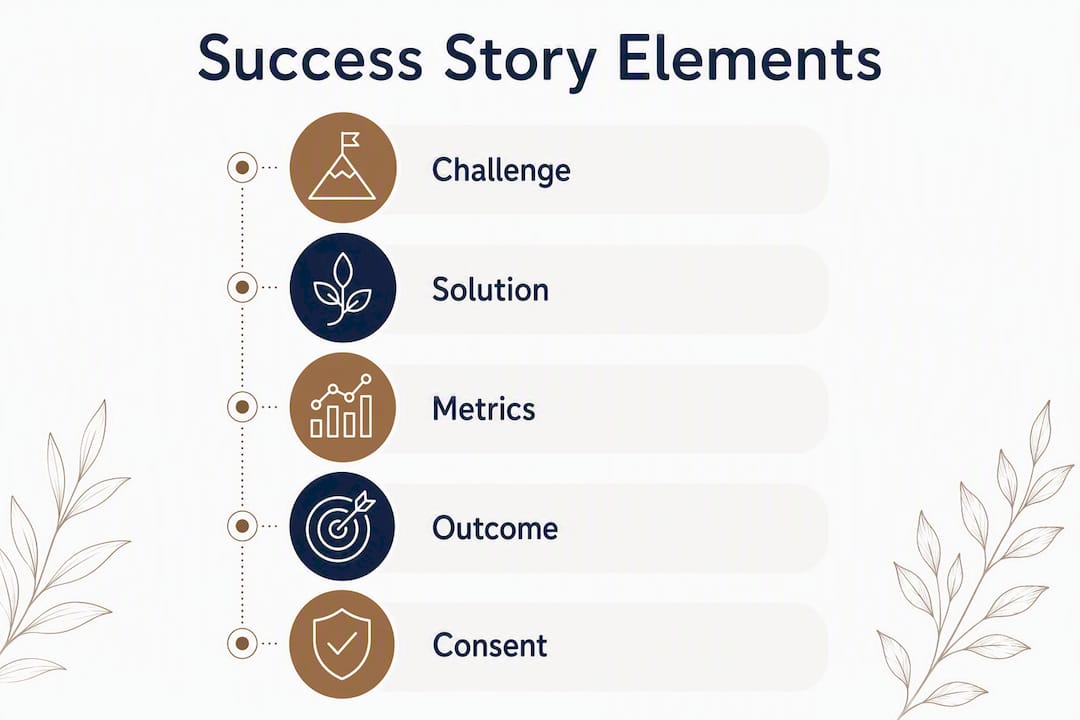
- What should every effective customer success story include?
- How do you build a repeatable story creation workflow?
- Where should you publish and repurpose customer success stories?
- How do you measure the ROI of customer success stories?
- Why do success stories influence buyers, and what are the risks?
- Key Takeaways
- The stories you never documented are the ones you’ll regret
What is the difference between a success story, case study, and testimonial?
These three terms get used interchangeably, but they serve different purposes and suit different moments in the buyer journey.

A testimonial is a short, attributed statement, typically one to three sentences, expressing satisfaction. It answers “Did it work?” but not “How?” A testimonial on a product page or sales email is low-friction social proof. Its weakness is that it lacks context: a buyer who is still evaluating options needs more than a quote.
A customer success story is a narrative. It follows a customer from a specific problem through a chosen solution to a measurable outcome. The structure is always some version of Challenge → Solution → Result, and the best ones include a direct quote, at least one concrete metric, and enough context that a similar buyer can see themselves in the story. Length ranges from a 400-word web page to a 1,500-word PDF, depending on the complexity of the sale.
A case study is the formal, long-form version of a success story, common in enterprise B2B. It often includes methodology, timeline, and supporting data. Think of it as a success story with footnotes.
Format by buyer-journey stage:
- Awareness: Short social micro-stories, pull quotes, and stat cards introduce the brand through peer outcomes.
- Consideration: Web-based success stories and one-page PDFs give prospects enough detail to self-qualify.
- Decision: Full case studies, video stories, and ROI-focused PDFs address the final objections a buyer brings to an internal approval meeting.
How do customer success stories actually change buyer behavior?
The role of customer success stories in marketing goes well beyond “social proof.” They change how buyers think, how fast deals close, and how marketing teams supply content across every channel.
Trust and credibility. Prospects distrust polished marketing because they know it is written to sell. A peer outcome, told in a customer’s own words, bypasses that skepticism. The U.S. Small Business Administration notes that Americans’ reliance on others’ opinions when buying, from consumer goods to enterprise software, makes testimonials and stories more important than ever.
Shortened sales cycles. B2B research indicates disproportionate consumption of case studies in the final 30% of the sales cycle, when a buyer is comparing options and building an internal business case. Handing a relevant story to a prospect at that moment gives them something to share with their own stakeholders.
Content for every channel. A single well-crafted case study supports multiple marketing objectives and retains value over time. One story becomes a blog post, a social card, a sales email snippet, a slide in a pitch deck, and a quote on a landing page.
Churn prevention and deeper adoption. Stories shared with existing customers show additional use cases and encourage them to get more from the product. That is a retention play, not just an acquisition one.
Stat to know: Case studies see disproportionate engagement in the final 30% of the B2B sales cycle, making timing of delivery as important as the story’s quality.
| Benefit | Concrete outcome | Best channel |
|---|---|---|
| Trust and credibility | Reduces buyer skepticism at first contact | Website homepage, landing pages |
| Shortened sales cycle | Speeds internal approval by giving buyers shareable proof | Sales email, proposal attachments |
| Content supply | One story feeds six or more formats | Blog, social, ads, email, PR |
| Churn prevention | Shows existing customers new use cases | Onboarding sequences, customer newsletters |
| Advocacy | Turns satisfied customers into active referrers | Partner programs, review platforms |
What should every effective customer success story include?
The challenge → solution → result structure is the most effective framework for customer stories because it mirrors how buyers think about their own problems. Here is what goes inside each section.
Headline formulas that work
- “How [Customer] reduced [problem] by [X%] in [timeframe]”
- “[Customer] went from [before state] to [after state] with [product/approach]”
- “[Customer type] solves [specific problem]: a [industry] story”
Metrics checklist
Not every story has hard numbers, but every story should have something measurable. Acceptable proof points include:
- Percentage improvement (time saved, cost reduced, results improved)
- Before/after comparison on a specific indicator
- Timeline to visible outcome
- Volume or frequency change (e.g., from monthly to weekly, from one to five)
When exact figures are unavailable, a qualified range is more credible than a vague claim. “Customers typically see results within four to eight weeks” beats “results vary.”
Consent and legal release checklist
Before publishing any customer story, confirm each of the following in writing:
- Written approval to use the customer’s name, company, and logo
- Sign-off on the specific quotes included
- Confirmation of the usage scope (website, ads, print, social)
- Agreement on any embargo or review period before publication
- Clarity on whether the customer can be contacted by press or prospects
Pro Tip: Build the release form into your post-purchase or post-onboarding workflow so it arrives when the customer’s enthusiasm is highest, not weeks later when momentum has faded.
How do you build a repeatable story creation workflow?
Producing one great story is easy. Producing a steady stream of them requires a process. Here is a workflow that marketing and customer success teams can run together.
-
Identify candidates. Look for customers who have achieved a clear, attributable result. Trigger events include a renewal, an upsell, a positive support interaction, or a strong review. Request the story after a clear attribution point when the customer can point to specific results.
-
Get internal alignment. Confirm with the account manager or customer success rep that the relationship is strong enough for a public story. A story request that arrives during a support issue will damage the relationship.
-
Send a pre-interview brief. Share three to five questions in advance so the customer can gather data. Sample questions: What was the core problem before you started? What did you try before this? What specific result can you point to now? What would you tell a peer considering the same decision?
-
Conduct a 20-minute interview. Record it with permission. Ask follow-up questions that push for specifics: “Can you put a number on that?” and “How long did it take to see that change?”
-
Write the first draft. Lead with the result in the headline. Open with the customer’s situation, not the product. Keep the customer as the hero; the product is the tool they used.
-
Route for approval. Send the draft to the customer contact and, if required, their legal or communications team. Build in a two-week review window.
-
Design and publish. Match the format to the intended channel (web page, PDF, video script). Tag the story in your CRM by industry, company size, use case, and outcome type.
-
Distribute and track. Share across channels and set up tracking links so you can measure engagement and attribution.
Pro Tip: Avoid selecting only your most dramatic results. Peer stories from customers with similar starting conditions produce stronger behavioral impact than outlier success stories, because readers see themselves in the narrative rather than dismissing it as exceptional.
Where should you publish and repurpose customer success stories?
A story that lives only on a case study page is leaving most of its value on the table. The repurposing flow below turns one interview into a month of content.
Long-form case study (website, PDF) is the source asset. Everything else derives from it.
From there: pull two or three direct quotes for use as testimonials on product pages and landing pages. Extract the headline metric for a social card or paid ad. Clip a 60-second video segment for LinkedIn or Instagram. Write a 200-word email version for a nurture sequence. Summarize the challenge and result in two sentences for a sales rep’s email signature or proposal template.
Channel-specific notes:
- Website: Organize stories by industry, use case, and company size so buyers can find a peer match quickly.
- Sales enablement: A one-page PDF version travels well in proposals and follow-up emails.
- Paid ads: Metric-led headlines (“Reduced recovery time by 40%”) outperform generic benefit claims in most B2B ad tests.
- PR: A strong result with a named customer is a ready-made pitch for trade publications.
- Onboarding: Stories showing how similar customers got started reduce early churn by setting realistic expectations.
Storytelling in fashion and beauty categories follows the same repurposing logic but places heavier emphasis on visual formats, before/after imagery, and emotional resonance alongside the metric. For brands like Cellure, where the outcome is visible on skin, pairing a customer quote with a photo sequence carries more weight than a percentage alone.
Pro Tip: Tailor which story you share to the buyer’s profile. A small-business owner evaluating a product responds to a story from a similar-sized company, not a Fortune 500 case study. Match the story’s protagonist to the prospect’s situation.
How do you measure the ROI of customer success stories?
Measurement is where most teams fall short. They publish stories and assume they work. The teams that prove value track specific KPIs and tie them to pipeline.
KPIs to track:
- Conversion lift on pages featuring a story vs. pages without one
- Deal velocity: average days from first contact to close for deals where a story was shared vs. those where it was not
- Win rate change when a story is included in the final proposal stage
- Content engagement: time on page, PDF downloads, video completion rate
- Pipeline influenced: total deal value where a story was accessed or shared during the sales process
Attribution approaches:
- Last-touch: Credits the story if it was the final content interaction before conversion. Simple but undervalues early-funnel exposure.
- Multi-touch: Distributes credit across all content interactions. More accurate for long B2B cycles.
- Assisted conversion: Flags any deal where a story was accessed at any point. Useful for proving that stories contribute even when they are not the final touchpoint.
| KPI | Measurement approach | Recommended tool |
|---|---|---|
| Conversion lift | A/B test story vs. no-story page variant | Google Optimize, VWO |
| Deal velocity | CRM report comparing story-touched vs. untouched deals | Salesforce, HubSpot |
| Win rate | Sales stage analysis filtered by story delivery | HubSpot, Gong |
| Content engagement | Page analytics, PDF tracking | Google Analytics 4, Paperflite |
| Pipeline influenced | Multi-touch attribution model in CRM | Salesforce, Marketo |
Tag every story asset in your CRM with a consistent taxonomy (industry, use case, outcome type) so you can filter reports by story type and identify which profiles drive the most pipeline.
Why do success stories influence buyers, and what are the risks?
Research from Cambridge shows that narratives can strongly alter beliefs even when the audience recognizes selection bias. Buyers who read a compelling success story update their expectations about typical outcomes, sometimes beyond what the evidence supports. That is powerful for marketing and a genuine responsibility.
“Simply showing outlier examples of success substantially affected participants’ beliefs about what makes a company successful — and being aware of the information’s bias was not enough to offset these effects.” — Annenberg School for Communication, University of Pennsylvania
Stories also function as diagnostic tools. Documenting stories systematically turns your marketing asset library into a feedback loop: the language customers use to describe their problems tells you how to rewrite your positioning; the outcomes they highlight tell you which product features actually matter.
Vicarious learning research adds a counterintuitive note: for complex decisions, a small number of well-chosen stories outperforms a large library. Flooding a late-stage buyer with fifteen case studies does not build more confidence. It creates decision fatigue.
Practical implications:
- Include scope notes in every story: company size, starting conditions, and timeframe. A result achieved by a 200-person company in six months is not automatically replicable by a five-person team in two weeks.
- Select peer-like stories for mid-to-late funnel delivery. Buyers with similar self-efficacy respond more strongly to stories from customers who started where they are now.
- Showcase a range of customer profiles and outcomes rather than only your best results, to give prospects a realistic picture of what is typical.
Key Takeaways
Customer success stories are your most persuasive sales and marketing asset when they are structured around peer outcomes, delivered at the right stage, and measured against pipeline KPIs.
| Point | Details |
|---|---|
| Structure drives credibility | Use Challenge → Solution → Result with at least one concrete metric in every story. |
| Timing determines impact | Case studies see disproportionate engagement in the final 30% of the B2B sales cycle; deliver peer stories at that stage. |
| One story, many formats | A single case study repurposes into social cards, email snippets, ads, and sales PDFs. |
| Measure against pipeline | Track conversion lift, deal velocity, and win rate to prove story ROI in your CRM. |
| Transparency prevents backlash | Include scope notes and a range of customer profiles to set realistic expectations. |
The stories you never documented are the ones you’ll regret
The most common mistake I see marketing teams make is not a bad story. It is no story at all, because no one built the habit of capturing them.
A sales rep closes a deal and moves on. A customer renews quietly and no one asks why. A product update solves a long-standing pain point and the team celebrates internally, then forgets to document what changed for the customer. Six months later, the team is trying to explain their value proposition to a new prospect and has nothing concrete to show.
The fix is not a big content initiative. It is one standardized intake form and a quarterly story audit. Every quarter, pull a list of customers who renewed, upsold, or left a positive review. Assign one person to send the intake form. The form asks three questions: What problem did you have? What changed? Can we share your story? That is the whole system. Most teams that build it are surprised by how many customers say yes.
For brands like Cellure, where the outcome is visible and personal, the story is already there. Customers notice when their skin looks different. The only question is whether you ask them to describe it in a way you can share. Pairing that story with ingredient transparency and measurable result indicators turns a personal experience into evidence that the next customer can trust.
Build the habit before you need the content. The stories are happening right now. Document them.
Useful sources and further reading
- Customer Testimonials: Maximize Their Marketing Impact | U.S. Small Business Administration — The SBA’s practical guide to generating and using testimonials for small businesses.
- Do Success Stories Cause False Beliefs About Success? | Annenberg School, UPenn — Research on how outlier success stories skew buyer expectations; essential reading for anyone writing or approving stories.
- Success stories cause false beliefs about success | Cambridge — The peer-reviewed study behind the Annenberg summary; useful for internal presentations on story ethics.
- The Power of Customer Storytelling | CustomerThink — Practitioner-focused overview of narrative structure and its role in customer success.