


Ingredient Transparency in Skincare: A Consumer Guide
TL;DR:
- Ingredient transparency ensures skincare products disclose all ingredients using INCI names mandated by US and EU law. Labels list ingredients by weight until 1% concentration, after which brands can order remaining ingredients arbitrarily, often hiding trace ingredients. Regulatory updates like MoCRA 2022 and third-party certifications increase accountability and help consumers identify genuinely transparent products.
Ingredient transparency in skincare is the regulated, standardized disclosure of every ingredient in a product, listed by concentration using International Nomenclature of Cosmetic Ingredients (INCI) names so you know exactly what you are applying to your skin. Both US law under 21 CFR Part 701 and EU Regulation (EC) No 1223/2009 mandate this format. The Modernization of Cosmetics Regulation Act of 2022 (MoCRA) has since raised the bar further, requiring product listings and adverse event reporting directly to the FDA. For anyone who reads labels before buying, understanding how these rules work, and where they fall short, is the foundation of smarter skincare choices.
What is ingredient transparency in skincare?
Ingredient transparency means every ingredient in a product is disclosed using its standardized INCI name, listed in descending order by weight. This is not a voluntary practice. US and EU regulations require it, and both specify a minimum font size of 1/16 inch so the list is actually readable on packaging.
INCI names are the same across markets. “Aqua” means water whether the product is made in France or Ohio. This standardization removes the guesswork that common names and marketing language create. A product labeled with “hydrolyzed wheat protein” in plain English and its INCI equivalent are describing the same thing, but only the INCI name is legally binding on the label.
The term “ingredient transparency” is widely used by consumers and marketers, but the formal industry concept is full ingredient disclosure, governed by cosmetic labeling law. Both phrases describe the same goal: giving you a complete, honest picture of what is in the formula.
How are skincare ingredient labels structured?
The ingredient list follows a strict hierarchy. Ingredients appear in descending order by weight until the concentration drops to 1% or below. After that threshold, brands can list remaining ingredients in any order they choose. This single rule explains more about a product than most marketing copy ever will.

Brands formulate most products with 70–80% water and a handful of base ingredients first. The top five ingredients define the product’s character. Everything after that serves as an active, a functional additive, or, in some cases, a marketing element.
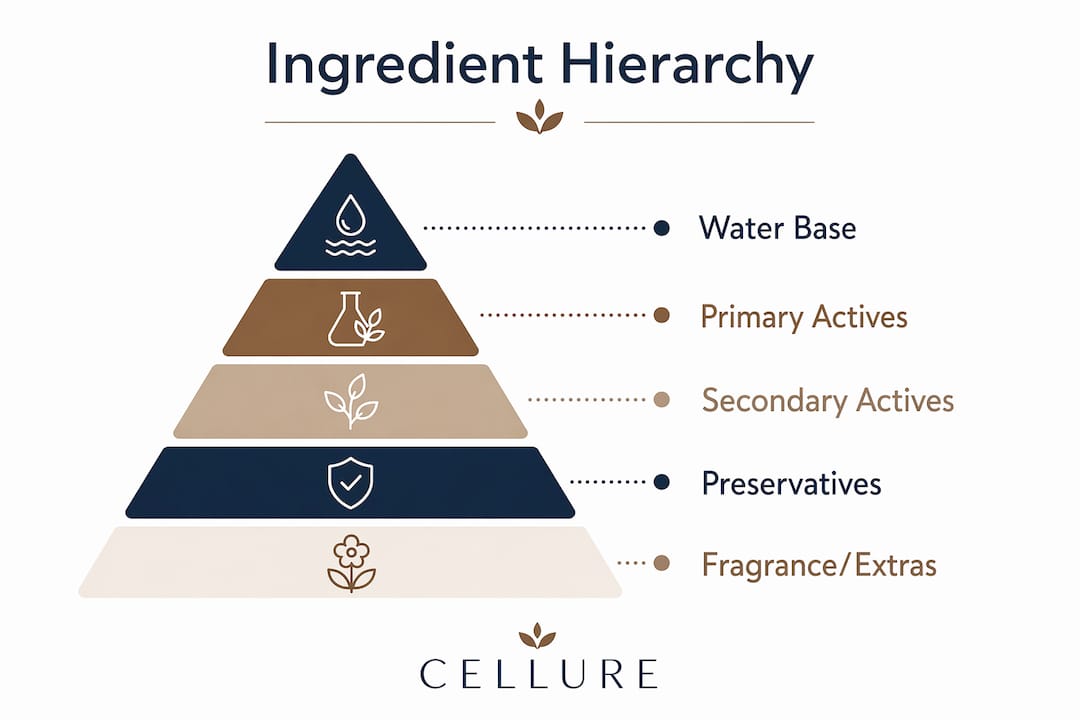
Reading the 1% marker
You will not see a line on the label that says “below 1% starts here.” Brands do not mark it. Instead, phenoxyethanol acts as a reliable marker: it is a common preservative regulated at a maximum of 1% concentration. Any ingredient listed after phenoxyethanol is almost certainly present at less than 1%.
This matters because active ingredients listed high on the list indicate functional concentrations, while those near the end may be present in amounts too small to have any real effect. A brand can legally list retinol, niacinamide, or a peptide complex near the bottom of the formula and still feature it prominently on the front of the packaging.
Key structural facts every label reader should know:
- Descending weight order applies to all ingredients above 1% concentration.
- Below 1%, ingredients can appear in any sequence the brand prefers.
- Active ingredients in regulated categories (like sunscreen actives) must be listed separately at the top, regardless of concentration.
- Fragrance appears as a single entry (“parfum” or “fragrance”) even when it contains dozens of individual compounds.
- Professional salon products are exempt from full retail ingredient declarations to end consumers.
Pro Tip: Scan for phenoxyethanol on any new product. Ingredients listed before it are present at meaningful concentrations. Ingredients listed after it are likely trace amounts, regardless of how prominently the brand markets them.
What certifications and regulations support honest labeling?
Regulatory compliance sets the floor. Third-party certifications raise it. Understanding both helps you separate genuinely transparent products from those that simply meet the legal minimum.
MoCRA 2022 is the most significant update to US cosmetic law in decades. Companies must now report serious adverse events within 15 business days and submit annual updates on product listings to the FDA. This creates a paper trail that did not previously exist and gives regulators real data on which products cause harm.
Third-party certifications go further than the law requires. EWG Verified confirms that a product contains no ingredients flagged as harmful by the Environmental Working Group’s database. NSF/ANSI 305 verifies organic content claims. NSF 527 checks formula integrity. These seals are not marketing badges. Each requires documentation and audit.
| Certification | What it verifies | Who issues it |
|---|---|---|
| EWG Verified | No harmful flagged ingredients; full disclosure | Environmental Working Group |
| NSF/ANSI 305 | Organic content percentage claims | NSF International |
| NSF 527 | Formula integrity and ingredient accuracy | NSF International |
| COSMOS Organic | Organic and natural ingredient sourcing | COSMOS standard |
The EU requires 26 known fragrance allergens to be disclosed separately on labels when they exceed specific concentration thresholds. The US has no equivalent rule yet. This gap means a product sold in Europe may carry more fragrance detail on its label than the identical formula sold in the US.
For consumers who want to go beyond label reading, INCI naming conventions provide a universal reference point that connects product labels to independent safety databases.
How do brands use misleading labeling tactics?
The most common transparency problem in skincare is not outright lying. It is strategic omission and the exploitation of legal gray areas.
Fragrance is the clearest example. Fragrance ingredients are listed generically as “parfum” because regulators treat the specific blend as a trade secret. A single “fragrance” entry can represent dozens of individual compounds, some of which are known allergens or sensitizers. Consumers with sensitivities have no way to identify the specific trigger from the label alone.
The second common tactic involves hero ingredient placement. Brands position sought-after actives near the 1% boundary to create the impression of a meaningful dose. The ingredient is technically present. Whether it is present at a concentration that produces any effect is a different question entirely.
Marketing terms add another layer of confusion. “Natural,” “clean,” “dermatologist-tested,” and “hypoallergenic” have no standardized legal definitions in the US. A brand can use any of these terms without meeting a specific ingredient standard. Label literacy is the only reliable defense against this kind of language.
Watch for these specific red flags when reading labels:
- A “hero” ingredient appears after phenoxyethanol on the list but is featured on the front of the packaging.
- The word “fragrance” or “parfum” appears without any further breakdown of components.
- Claims like “natural” or “clean” appear without a supporting certification seal.
- The ingredient list is printed in a font smaller than 1/16 inch, which is below the legal minimum.
Pro Tip: Search any ingredient you do not recognize in the EWG Skin Deep database. It provides independent safety scores based on available research, which gives you a second opinion beyond the brand’s own claims.
How to evaluate skincare products for genuine transparency
Evaluating a product’s honesty takes less than five minutes once you know the method. Here is a repeatable process:
-
Read the INCI list first, not the front label. The front is marketing. The back is the legal record. Start there and ignore claims like “powered by vitamin C” until you find ascorbic acid or sodium ascorbyl phosphate on the ingredient list.
-
Locate phenoxyethanol or a similar 1% marker. Everything above it is present at a meaningful concentration. Everything below it may be decorative. Adjust your expectations for “hero” ingredients accordingly.
-
Check for fragrance disclosure. A product that lists “fragrance” or “parfum” without further detail is hiding its scent formula. Products labeled “fragrance-free” or those that disclose individual aromatic compounds offer greater transparency for sensitive skin.
-
Look for third-party certification seals. EWG Verified, NSF/ANSI 305, and COSMOS Organic each require documentation that goes beyond self-reported claims. A seal from one of these organizations means an outside party has checked the formula.
-
Cross-reference with EWG Skin Deep. The EWG Skin Deep database allows independent ingredient safety evaluation beyond what the label tells you. Search the product or its individual ingredients for safety ratings based on published research.
-
Verify MoCRA compliance signals. Brands that voluntarily list their products with the FDA and publish their adverse event reporting practices are signaling a higher level of accountability. This information is sometimes available on brand websites or in product documentation.
Brands that practice clinically supported skincare go further than legal minimums. They publish the rationale behind ingredient selection, disclose concentrations where possible, and avoid vague marketing language in favor of specific claims tied to published research.
Key takeaways
Genuine ingredient transparency requires regulatory compliance, label literacy, and third-party verification working together, not any single factor alone.
| Point | Details |
|---|---|
| INCI names are the standard | Always read the INCI ingredient list, not front-label marketing claims, to understand what a product contains. |
| The 1% rule shapes every list | Ingredients above 1% appear by weight; below that threshold, order is the brand’s choice and may not reflect importance. |
| Fragrance hides ingredients | “Parfum” or “fragrance” can conceal dozens of compounds; seek fragrance-free or fully disclosed formulas. |
| Certifications add accountability | EWG Verified, NSF/ANSI 305, and NSF 527 require independent audits that marketing claims do not. |
| MoCRA 2022 raised the bar | US brands must now report serious adverse events within 15 business days, creating real regulatory accountability. |
Why transparency is the only metric that actually matters
I have spent years reading skincare labels, and the single most reliable predictor of a trustworthy product is not the price, the packaging, or the brand story. It is whether the company is willing to show you exactly what is in the formula and explain why each ingredient is there.
The transparency gap I see most often is not fraud. It is the quiet exploitation of legal minimums. A brand can technically comply with 21 CFR Part 701 and still hide the majority of its fragrance blend, bury a hero ingredient below the 1% line, and plaster “dermatologist-tested” across the front without a single clinical study to back it up. All of that is legal. None of it is honest.
What I find encouraging is that regulatory pressure is moving in the right direction. MoCRA 2022 is the first meaningful update to US cosmetic law in decades, and it creates real accountability through adverse event reporting. The EU’s requirement to disclose 26 specific fragrance allergens is a model the US should follow. These are not small changes. They shift the burden of proof toward brands and away from consumers.
My advice is straightforward. Develop label literacy before you develop brand loyalty. Learn to find phenoxyethanol. Learn to search EWG Skin Deep. Learn what signs of effective skincare actually look like on your skin versus what the packaging promises. Transparency drives better formulation because brands that disclose everything have nowhere to hide. That accountability is what pushes the industry toward products that actually work.
— Sara
Cellure’s approach to ingredient disclosure
Cellure publishes full INCI ingredient lists for every product in its lineup, with no proprietary blends obscuring what goes into each formula. The brand uses bioactive ingredients like peptides, tranexamic acid, and polynucleotides at concentrations chosen for cellular effect, not label positioning.
For consumers who want a starting point that combines transparent labeling with regenerative science, the Complete Skin Repair Kit brings together Cellure’s core actives in a single, clearly documented system. Every ingredient is listed, every concentration is chosen for function, and the science behind each choice is available on the Cellure website. If you have been looking for a brand that treats the ingredient list as a commitment rather than a formality, that is the standard Cellure holds itself to.
FAQ
What does ingredient transparency in skincare mean?
Ingredient transparency means every ingredient in a skincare product is disclosed using standardized INCI names, listed in descending order by weight, as required by US and EU cosmetic labeling law.
How do I find the 1% threshold on an ingredient label?
Look for phenoxyethanol on the list. It is a common preservative regulated at a maximum of 1%, so ingredients listed after it are almost certainly present at less than 1% concentration.
Are marketing terms like “clean” or “natural” regulated?
No. In the US, terms like “clean,” “natural,” and “dermatologist-tested” have no standardized legal definitions. Only third-party certifications like EWG Verified or NSF/ANSI 305 provide independently verified standards.
What is MoCRA 2022 and why does it matter?
MoCRA 2022 is the Modernization of Cosmetics Regulation Act, which requires US brands to report serious adverse events to the FDA within 15 business days and submit annual product listing updates, creating greater federal oversight of cosmetic safety.
Why is fragrance a transparency problem in skincare?
Fragrance is listed as a single entry (“parfum”) on ingredient labels because regulators treat the specific blend as a trade secret. This single entry can represent dozens of individual compounds, including known allergens, with no further disclosure required under US law.