


How to Build a Skincare Routine That Actually Works
TL;DR:
- A simple, consistent skincare routine with four core steps effectively addresses aging, acne, dryness, and uneven tone.
- Following proper product order, matching products to skin type, and introducing actives gradually improve results and prevent irritation.
A skincare routine is defined as a consistent, sequenced set of steps applied to the face to cleanse, treat, protect, and repair skin at the cellular level. Knowing how to build a skincare routine correctly means following four science-backed steps: cleanse, treat with targeted serums, moisturize, and apply sunscreen. Dermatologists consistently confirm that simplicity and consistency outperform complex, multi-step regimens for most adults. Whether your concern is aging, acne, dryness, or uneven tone, these four steps address the root causes without overwhelming your skin or your schedule.
How to build a skincare routine: the four core steps
Every effective routine rests on four steps. Each one has a specific job, and skipping any of them creates a gap that products alone cannot fill.
Step 1: Cleanse
Gentle cleansing twice daily removes debris, excess oil, and environmental pollutants without stripping the skin’s natural oils. Stripping those oils damages the skin barrier, which leads to irritation, breakouts, and accelerated moisture loss. Use a mild, sulfate-free cleanser in the morning and evening. Avoid scrubbing or using water that is too hot, since both weaken the barrier over time.

Step 2: Treat with serums
Serums deliver concentrated active ingredients directly to the skin. Morning routines call for antioxidant serums like Vitamin C, which neutralize free radicals from UV exposure and pollution. Evening routines prioritize retinoids, which are the gold standard for aging and skin texture improvement. Retinoids accelerate cell turnover and stimulate collagen production, but they require gradual introduction to avoid irritation.
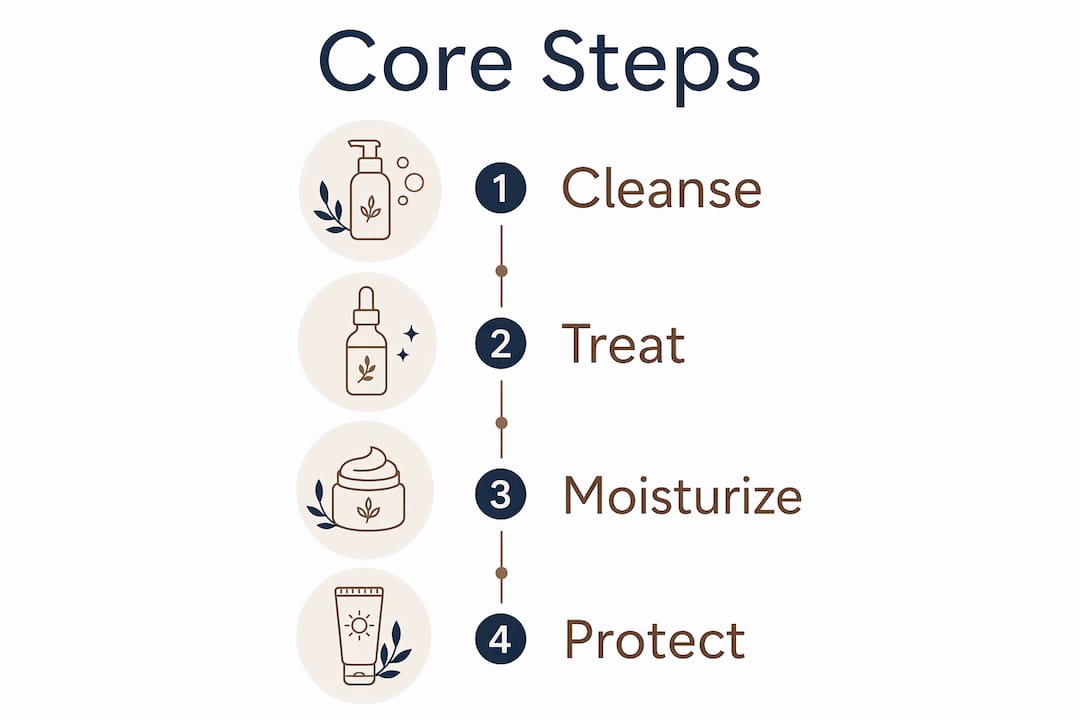
Step 3: Moisturize
Moisturizers do not simply add water to the skin. They seal and repair the skin barrier, reducing the risk of eczema, sensitivity, and chronic dryness. Apply moisturizer within three minutes of cleansing to lock in residual hydration. Twice-daily application is the clinical standard.
Step 4: Protect with SPF
SPF 30 or higher applied daily is the single most effective anti-aging step in any routine. Sunscreen blocks UV radiation, which causes collagen breakdown, pigmentation, and skin cancer. Reapply every two hours when outdoors. Sunscreen applies even on cloudy days, since UV rays penetrate cloud cover.
Pro Tip: Apply your moisturizer within three minutes of washing your face. That short window locks in hydration before the skin surface dries out completely.
- Cleanse morning and night with a gentle, sulfate-free formula.
- Apply a Vitamin C serum in the morning after cleansing.
- Use a retinoid serum at night, starting two to three times per week.
- Moisturize immediately after serums, morning and night.
- Finish your morning routine with broad-spectrum SPF 30 or higher.
How do you identify your skin type and choose the right products?
Skin type determines which textures and ingredients work best for you. The simplest way to identify your type is to cleanse your face, wait 30 minutes without applying anything, and observe how your skin behaves.
- Oily skin looks shiny across the forehead, nose, and chin. It benefits from gel cleansers, lightweight water-based moisturizers, and niacinamide serums that regulate sebum.
- Dry skin feels tight and may flake. It needs cream cleansers, rich moisturizers with ceramides or hyaluronic acid, and gentle actives like lactic acid rather than harsh exfoliants.
- Combination skin is oily in the T-zone and normal or dry on the cheeks. A balanced gel-cream moisturizer and a mild foaming cleanser work well here.
- Sensitive skin reacts easily to fragrance, alcohol, and strong actives. Fragrance-free, minimal-ingredient formulas reduce the risk of flares.
- Mature skin benefits from peptides, polynucleotides, and retinoids to address firmness loss and uneven tone. Cellure’s formulations target exactly this profile, using clinically supported bioactives for gentle skincare for aging skin.
Choosing fragrance-free and non-comedogenic products reduces irritation risk across all skin types. Introducing active ingredients gradually is the clinical standard. Start with one active ingredient used two to three times per week, then increase frequency as your skin tolerates it.
Pro Tip: Patch test every new product on the inside of your wrist or behind your ear for 24 hours before applying it to your face. This one step prevents most reaction flares.
What is the correct order to apply skincare products?
Product order is not a preference. It is a functional requirement. Applying products from thinnest to thickest ensures each layer penetrates properly. A thick cream applied before a serum physically blocks the serum from reaching the skin. That means you paid for an ingredient that never absorbed.
The correct sequence for your morning routine:
- Cleanser
- Toner (optional, applied with a cotton pad or hands)
- Vitamin C serum or other antioxidant treatment
- Eye cream (if used, applied before heavier creams)
- Moisturizer
- SPF (always last in the morning)
The evening sequence follows the same logic, with retinoids replacing the Vitamin C serum and no SPF at the end.
Common layering mistakes include mixing Vitamin C with chemical exfoliants like AHAs or BHAs. Combining incompatible actives disrupts pH balance and causes irritation without delivering better results. Use Vitamin C in the morning and exfoliants in the evening on separate days when you are starting out.
| Product type | When to apply | Key function |
|---|---|---|
| Cleanser | Morning and evening | Removes debris and prepares skin |
| Antioxidant serum | Morning | Defends against UV and pollution damage |
| Retinoid serum | Evening | Repairs and renews skin cells |
| Moisturizer | Morning and evening | Seals and supports the skin barrier |
| SPF 30+ | Morning only | Blocks UV radiation |
For a deeper look at sequencing, Cellure’s guide on the skincare layering process breaks down each step with ingredient-specific guidance.
How to build a personalized routine for your lifestyle and concerns
A personalized routine starts with identifying your top one or two skin concerns. Trying to address acne, aging, pigmentation, and dryness all at once with different actives overloads the skin and makes it impossible to know what is working.
- Name your primary concern. Choose one: acne, aging, pigmentation, or dryness. Build your serum choice around that concern first.
- Add a second concern only after six weeks. Consistency over 6–12 weeks is necessary before you can evaluate whether a product is working. Switching too soon wastes time and money.
- Differentiate morning and evening. Morning protects. Evening repairs. Vitamin C and SPF belong in the morning. Retinoids and richer moisturizers belong at night.
- Introduce one new product at a time. Adding multiple products simultaneously makes it impossible to identify the cause of any reaction.
- Support your routine with daily habits. Sleep, hydration, and a diet low in processed sugar all affect skin quality. No serum compensates for chronic sleep deprivation or dehydration.
Peptides and polynucleotides are worth noting for adults focused on aging. These ingredients support collagen synthesis and cellular repair at a level that basic moisturizers cannot reach. Cellure specializes in these bioactives, and their targeted serums are formulated to work within a four-step routine without adding unnecessary complexity.
Pro Tip: Keep a simple photo log of your skin every two weeks under the same lighting. Progress in skincare is slow and easy to miss day-to-day. Photos make it visible.
Tracking whether your routine is delivering results matters as much as the routine itself. Cellure’s resource on signs of effective skincare outlines nine specific indicators to watch for, from texture changes to tone evenness.
Key Takeaways
A consistent four-step routine of cleansing, treating, moisturizing, and daily SPF delivers better results than any complex multi-product regimen applied without structure or patience.
| Point | Details |
|---|---|
| Four steps are enough | Cleanse, treat, moisturize, and protect covers every core skin need. |
| Order determines efficacy | Apply products thinnest to thickest so each ingredient actually absorbs. |
| Skin type guides product choice | Match cleanser and moisturizer textures to your skin type to avoid barrier damage. |
| Consistency beats complexity | Commit to a routine for 6–12 weeks before evaluating results or making changes. |
| One active at a time | Introduce new actives gradually and patch test to prevent irritation. |
Why I think most people overcomplicate their skincare
The most common mistake I see is not neglect. It is overcomplication. Adults spend real money on eight-step routines they abandon within two weeks because the regimen is unsustainable. Then they conclude that skincare “doesn’t work for them,” when the actual problem was the routine, not their skin.
The evidence is clear. Routines tailored by skin type and goals consistently outperform complicated regimens. Complexity creates more opportunities for incompatible ingredients to clash, for barrier damage to accumulate, and for the person to simply give up.
What I have found actually works is this: pick the fewest products that address your real concerns, use them correctly and in order, and give them time. Retinoids take weeks to show results. Vitamin C serums need consistent morning use to build antioxidant defense. SPF needs to be reapplied, not just applied once and forgotten.
The other thing worth saying plainly: price does not determine efficacy. Correct sequencing and texture layering matter far more than the brand on the bottle. A $15 moisturizer applied correctly beats a $150 one layered under a serum that blocks its absorption. Spend your money on ingredients with clinical evidence behind them, like peptides, retinoids, tranexamic acid, and broad-spectrum SPF. Everything else is optional.
— Sara
Cellure’s Complete Skin Repair Kit: where science meets simplicity
Cellure builds its products around the same four-step framework this article describes. The Complete Skin Repair Kit is formulated with peptides, polynucleotides, and tranexamic acid to support cleansing, cellular treatment, barrier repair, and skin renewal in one cohesive system. Every ingredient is chosen for clinical backing, not marketing appeal. The kit suits all skin types and is designed specifically for adults addressing aging-related concerns like firmness loss, uneven tone, and volume reduction. If you are ready to move from guessing to a structured, science-supported regimen, Cellure’s advanced cellular regeneration approach gives you a clear starting point.
FAQ
What are the basic steps for a skincare routine?
A basic routine includes four steps: cleanse, apply a treatment serum, moisturize, and apply SPF in the morning. These four steps address the core needs of every skin type.
How long does it take to see results from a new skincare routine?
Visible results typically require 6–12 weeks of consistent use. Switching products before that window closes makes it impossible to evaluate what is actually working.
What order should I apply skincare products?
Apply products from thinnest to thickest texture. The standard sequence is cleanser, toner (optional), serum, eye cream, moisturizer, and SPF in the morning.
Can I use Vitamin C and retinol together?
Use Vitamin C in the morning and retinol at night on separate schedules. Combining them in the same application can cause pH imbalance and irritation without added benefit.
How do I know if my skincare routine is working?
Look for gradual improvements in texture, tone evenness, and hydration over six to twelve weeks. Sudden breakouts, redness, or tightness signal that a product or layering order needs adjustment.