


Check pH and Packaging First to Avoid Copper Peptide Side Effects
Topical copper peptides are safe for most people, and side effects tend to be mild and short-lived: transient redness, stinging, or itching as skin adjusts. Serious reactions are rare but real, usually tied to a genuine copper allergy or a poorly stabilized product shedding free copper ions. Patch test any new serum on your inner forearm for 48 hours before applying it to your face, and stop immediately if you notice swelling, burning that doesn’t fade, or a spreading rash.
TL;DR:
- Most side effects of copper peptides are mild and local, including redness, stinging, or itching, which typically fade within one to two weeks.
- Proper formulation requires maintaining the peptide’s stability through controlled pH levels, storage away from heat and light, and avoiding strong chelators that can release free copper ions.
- Skin reactions, such as persistent redness or signs of degradation like color changes, indicate the product may be compromised and should be discarded.
- Individuals with copper allergies, Wilson’s disease, or skin conditions like eczema and rosacea should avoid copper peptides or consult a healthcare professional before use.
- Introducing copper peptides gradually, patch testing, and storing the product properly help minimize irritation and ensure safe, effective application.
Table of Contents
- What Are the Common Side Effects of Copper Peptides?
- Why Do Copper Peptides Cause Irritation in the First Place?
- Who Should Avoid Copper Peptides Entirely?
- How Do You Start Copper Peptides Without Triggering a Reaction?
- What Ingredients Should You Never Mix with Copper Peptides?
- What Should You Do If You React to Copper Peptides?
- How Cellure Approaches Copper Peptide Safety
- The Real Risk Isn’t the Copper. It’s the Bottle.
- Sources
- FAQ
What Are the Common Side Effects of Copper Peptides?
Most people who try a copper peptide serum notice nothing dramatic at all. When reactions do happen, they show up early and stay local.
- Redness or flushing, usually within the first few applications
- Stinging or tingling, especially on freshly cleansed or exfoliated skin
- Itching, mild and often fading within one to two weeks
- Dryness or tightness, more common with higher-frequency use
- Rare contact sensitization, where skin develops a true allergic response over repeated exposure
Dermatologists who track GHK-Cu (the copper peptide most common in skincare) describe it as generally well tolerated, with irritation as the main complaint rather than anything more severe, according to Westlake Dermatology’s clinical review of the ingredient.
Pro Tip: Redness that shows up in the first ten minutes and fades within an hour is usually just vasodilation, not an allergic reaction. Redness that lingers past a day, or comes with heat and swelling, deserves more attention.
You may have come across “copper uglies,” an online term for skin that supposedly looks worse before it improves on copper peptides. It’s anecdotal, not a documented clinical syndrome, and the theory behind it deserves its own explanation, which is what formulation chemistry actually clarifies.
Why Do Copper Peptides Cause Irritation in the First Place?
Copper peptides don’t cause irritation because copper itself is harsh. They cause irritation when the formulation fails to keep copper bound where it belongs.
GHK-Cu is a fragile molecule. It needs a fairly narrow pH window, roughly 5.0 to 5.5, along with cool storage and protection from light to stay intact, according to Runke’s formulation and stability guide. Heat, sunlight exposure, or contact with strong chelating agents can break the peptide bond and release free copper ions into the formula.
- Free copper ions can drive Fenton-like oxidative reactions, generating reactive byproducts that irritate skin rather than repair it
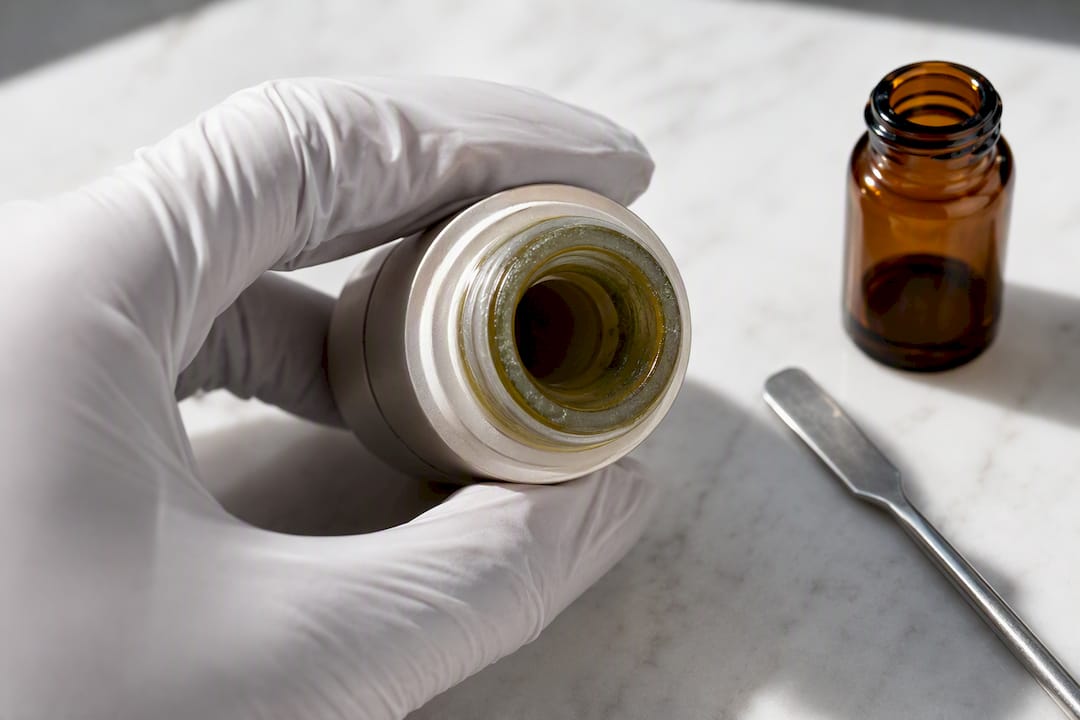
- Degraded product often shows visible signs: a color shift from blue toward green or brown, or a cloudy precipitate settling at the bottom of the bottle
- A serum that looks different than it did the week you bought it is telling you something about its chemistry
There’s also a theoretical mechanism behind the “copper uglies” idea worth taking seriously, even if the evidence is thin. Small studies show GHK-Cu can upregulate MMP-1 and MMP-2, enzymes involved in breaking down old collagen so new collagen can form, per findings summarized by Innerbody’s review of GHK-Cu peptide research. That remodeling process is normally beneficial, but it means skin can look temporarily rougher during turnover. Large-scale clinical confirmation of a distinct “copper ugly” phase doesn’t exist yet.
Pro Tip: If a copper peptide product has changed color or developed a film on top, don’t use it, no matter how much of the bottle is left. Degraded copper peptides do more harm than good.
Who Should Avoid Copper Peptides Entirely?
A small subset of people should skip topical copper peptides altogether or clear it with a doctor first.
- Anyone with a known copper allergy should avoid these products outright, since even trace exposure can trigger a reaction
- People with Wilson’s disease, a rare genetic disorder that causes copper to accumulate in the liver and brain, should not use copper-containing topicals without medical guidance, even though absorption through intact skin is limited
- Those with eczema, rosacea, or active contact dermatitis should patch test more cautiously, since a compromised skin barrier absorbs more of everything, irritants included
- Anyone with recent chemical peels, laser treatments, or open wounds should wait until the skin barrier has recovered
- Pregnant, immunosuppressed, or chronically wounded patients should talk to a clinician before starting any investigational or injectable copper peptide product, since those forms are far less studied than topical serums
How Do You Start Copper Peptides Without Triggering a Reaction?
Introducing copper peptides slowly does more to prevent side effects than any product claim on the label.
- Patch test first. Apply a small amount to your inner forearm and leave it for 48 to 72 hours. Watch for redness, itching, or bumps before putting it anywhere near your face.
- Start every other day. Give your skin a few applications a week before moving to daily use, and only increase frequency if you see no irritation.
- Stick to conservative concentrations. Most finished serums use somewhere around 0.1% to 0.3% active GHK-Cu; formulators note that concentrations above roughly 0.5% to 1% raise the risk of staining and irritation without adding real benefit, based on Runke’s stability and usage guidance.
- Watch your layering. Copper peptides generally work best at night; save stronger actives for a separate part of your routine.
- Store it properly. Keep the bottle in opaque packaging, out of direct sunlight, and somewhere cool. Bathroom shelves next to a hot shower are the worst spot for it.
Pro Tip: If your skin tolerates copper peptides for two weeks straight with no irritation, that’s your signal to move to daily use, not a reason to add more product per application.
What Ingredients Should You Never Mix with Copper Peptides?
Some of the most popular skincare actives actively work against copper peptides, and the chemistry explains why.
- L-ascorbic acid (pure vitamin C) is a strong reducing agent that can strip copper right off the peptide, deactivating it and potentially generating irritating byproducts in the process
- AHAs and BHAs create a low-pH environment that destabilizes the copper-peptide bond, similar to what excess heat or light does
- EDTA and other strong chelators, common in many formulas as preservative boosters, bind copper directly and pull it away from the peptide
- High-concentration reducing agents and some thiol-containing peptides can interfere with copper peptide stability through similar chemical pathways
Formulators generally recommend keeping vitamin C and copper peptides in separate steps of your routine, using vitamin C in the morning and copper peptides at night, according to GINKVORA’s technical formulation guide. If you want a shortcut to keep that schedule straight, Cellure’s layering rules for deciding whether peptides go morning or night walk through the timing logic step by step.
What Should You Do If You React to Copper Peptides?
Most reactions resolve on their own once you stop the product, but knowing the difference between “annoying” and “urgent” matters.
For mild irritation:
- Stop using the product immediately
- Rinse the area with cool water
- Apply a cold compress if skin feels hot or swollen
- Take an over-the-counter antihistamine if you notice localized hives
For anything beyond mild irritation, treat it as an emergency. Call emergency services or go to an ER if you experience difficulty breathing, swelling of the face or tongue, or widespread blistering. Once the acute reaction has passed, follow up with a dermatologist for formal patch testing, especially if you plan to try other copper-based products later or suspect a broader metal allergy.
How Cellure Approaches Copper Peptide Safety
The formulation of copper peptide products should prioritize clinically supported bioactive ingredients to ensure copper peptide stability from the start.
- Effective copper peptide products require careful attention to pH balance and ingredient compatibility, which determine whether copper peptides stay stable or degrade into irritants.
- Cellure’s educational resource on copper peptides in skin repair breaks down the chemistry behind GHK-Cu for readers who want the deeper science
- For anyone with reactive or easily irritated skin, Cellure’s guide to peptide serums suited for sensitive skin covers formulations built around tolerance first
If you’re weighing copper peptides against other repair-focused actives, it helps to understand how peptides function across skincare more broadly, since copper peptides are one branch of a much larger peptide category. Readers who want a formulated option built with these stability safeguards in mind can look at Cellure’s Complete Skin Repair Kit, designed around the same pH and compatibility principles covered here.
The Real Risk Isn’t the Copper. It’s the Bottle.
The conventional wisdom on copper peptides treats them like a single monolithic ingredient with a single safety profile. That’s the wrong frame.
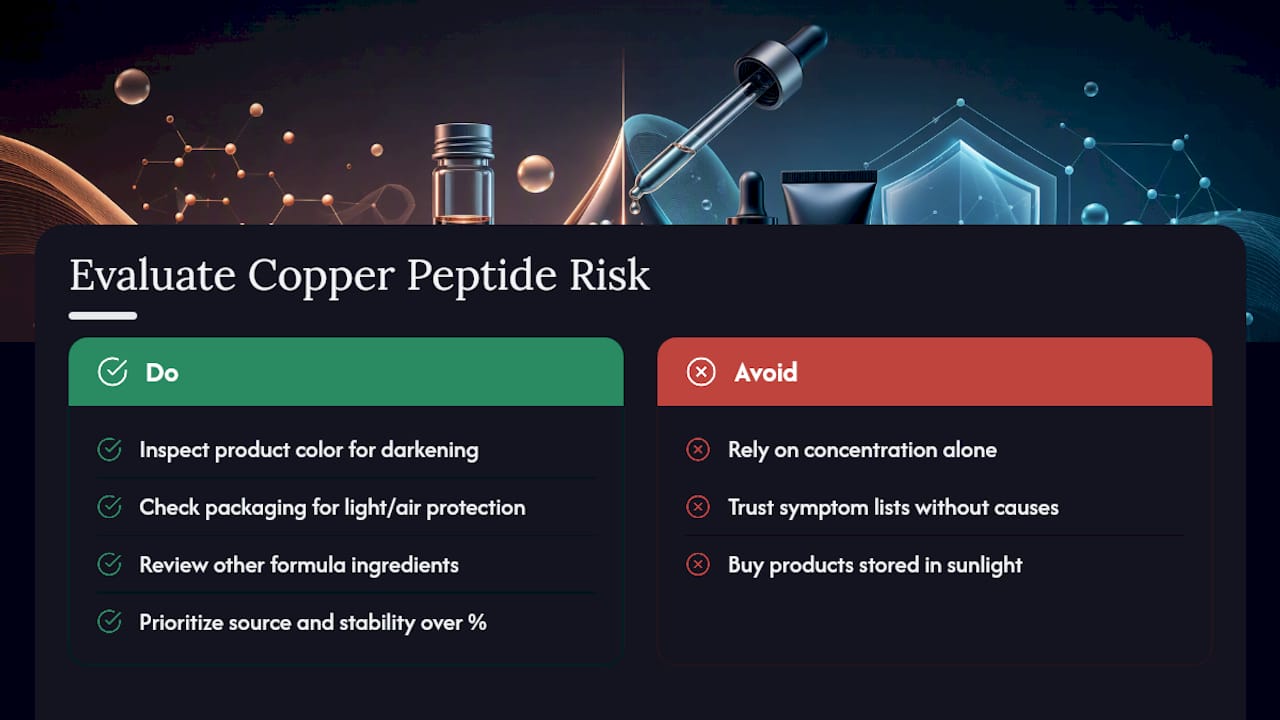
Most articles on this topic list symptoms without explaining why they happen, which leaves readers unable to tell a normal adjustment reaction from a sign of a bad product. Understanding that free copper, not bound copper peptide, drives most of the oxidative irritation gives you something more useful than a symptom list: a way to evaluate the product itself. Check for color changes. Check the packaging. Check what else is in the formula before you check what a listicle says about side effects.
If you take one thing from this, prioritize source and stability over concentration. A lower percentage in a stable, well-packaged formula will treat your skin better than a higher percentage in something that’s been sitting on a sunny shelf for six months.
— Sara
This article is general information, not a substitute for advice from a qualified doctor. Consult a qualified healthcare professional about your own circumstances before acting on anything here.
Sources
- A Dermatologist’s Take on the Copper Peptide (GHK-Cu) Skin Care Trend — Westlake Dermatology
- Bulk Copper Peptide (GHK-Cu): Formulation & Stability Guide — Runke
- GHK-Cu Formulation technical guide — GINKVORA
FAQ
Can I use copper peptides every day?
Yes, once your skin tolerates it. Most dermatology sources recommend starting every other day and moving to daily use only if you see no irritation after about two weeks, since overuse can increase inflammation rather than improve results, per Westlake Dermatology’s clinical take on GHK-Cu.
What are signs of too much copper in your body?
Systemic copper overload is extremely rare from topical skincare and is mainly associated with conditions like Wilson’s disease rather than serum use. Watch instead for local skin signs of a bad reaction: persistent burning, swelling, or a spreading rash, and seek medical care if you notice fatigue, jaundice, or abdominal pain alongside skin symptoms, since these could point to an unrelated underlying issue.
What not to mix with copper peptides?
Avoid pairing copper peptides with L-ascorbic acid (pure vitamin C), AHAs or BHAs, and strong chelators like EDTA, since these can strip copper from the peptide and reduce its effectiveness, according to GINKVORA’s formulation guidance. Use vitamin C in the morning and copper peptides at night instead.
Who should avoid using GHK-Cu peptide?
Anyone with a diagnosed copper allergy or Wilson’s disease should avoid it. People with eczema, rosacea, or a compromised skin barrier should patch test carefully before regular use, and pregnant or immunosuppressed individuals should check with a clinician first.