


10 Skincare Myths Debunked by Dermatology Research
Most of what you’ve heard about skincare is wrong, or at least badly oversimplified. The three things that actually move the needle on skin health are daily broad-spectrum sunscreen, a retinoid used consistently, and a routine that repairs your skin barrier instead of stripping it. Everything else, from pore-shrinking claims to the idea that expensive serums work better, falls apart under real scrutiny.
The Skin Cancer Foundation and the American Academy of Dermatology have said this for years: UVA rays pass through clouds and glass, so sunscreen needs to be a daily habit, not a beach-day accessory. Harvard Health has also confirmed that topical retinoic acid has the strongest evidence of any anti-aging ingredient for reducing wrinkles.
Here’s what to do right now:
- Apply broad-spectrum sunscreen with SPF 30 or higher every morning, regardless of weather or indoor/outdoor setting.
- Introduce a retinoid slowly, two to three nights a week at first.
- Treat barrier repair (not extra water or harsh scrubs) as your hydration strategy.
Pro Tip: If you only fix one habit this year, make it sunscreen. It’s the single intervention with the most consistent backing across dermatology research.
Key Takeaways
Daily sunscreen, consistent retinoid use, and topical barrier repair outperform nearly every popular skincare myth combined.
| Point | Details |
|---|---|
| Sunscreen is non-negotiable | Apply SPF 30+ daily since UVA penetrates clouds and glass year-round. |
| Retinoids build, not thin | Consistent use stimulates collagen over 8 to 16 weeks rather than damaging skin. |
| Pores can’t shrink, only appear smaller | Use exfoliation, niacinamide, or a retinoid to reduce their visible size. |
| Skip DIY spot treatments | Household remedies like toothpaste irritate skin; use benzoyl peroxide or salicylic acid instead. |
| Price doesn’t predict performance | Formulation and active concentration matter more than cost, a principle behind Cellure’s evidence-focused serums and kits. |
Table of Contents
- Common Skincare Myths Debunked, One by One
- Building a Routine That Replaces These Habits
- What the Clinical Evidence Actually Shows
- Does the Order You Apply Products Actually Matter?
- Do You Really Need a Different Routine Every Season?
- Are Natural Exfoliants Automatically Gentler?
- Does Wearing Makeup Cause Breakouts?
- Does Hot or Cold Water Change Your Pore Size?
- Should You Ever Pop a Pimple Yourself?
- Frequently Asked Questions
- Sources
Common Skincare Myths Debunked, One by One
Skincare advice spreads fast because it sounds logical. Most of it just doesn’t hold up once you check it against actual clinical evidence. Here’s a myth-by-myth breakdown of the claims worth retiring for good.
-
“You only need sunscreen when it’s sunny.” UVA radiation travels through cloud cover and window glass, so skin ages and burns even on gray days or during a long commute. Wear SPF 30 or higher every single day, regardless of the forecast.
-
“Retinol permanently thins your skin.” It does the opposite over time. Early use can make the outer layer feel thinner because it speeds up cell turnover, but sustained use of retinoids stimulates collagen production and thickens the deeper skin layers. Expect visible improvement in fine lines somewhere between 8 and 16 weeks of consistent use.
-
“You can shrink your pores.” Pore size is set by genetics, sebaceous gland activity, and age. No product changes their actual diameter. What you can do is reduce their visible appearance with regular exfoliation, niacinamide, or a retinoid.
-
“Oily skin doesn’t need moisturizer.” Skipping moisturizer on oily skin often triggers more oil production as skin tries to compensate for dehydration. A lightweight, non-comedogenic moisturizer keeps oil production balanced without clogging pores.
-
“Drinking more water hydrates your skin.” There’s no reliable evidence that extra water intake improves surface skin hydration in people who aren’t clinically dehydrated. Topical humectants like hyaluronic acid and glycerin, paired with an occlusive layer, do the actual work of retaining moisture in skin.
-
“Tanning beds are a safe way to get vitamin D.” Tanning beds emit concentrated UV radiation that accelerates photoaging and raises skin cancer risk. Vitamin D from a supplement or a short walk outside carries none of that risk.
-
“Aggressive scrubbing exfoliates better.” Scrubbing hard damages the skin barrier and increases sensitivity and irritation rather than delivering a deeper clean. Gentle exfoliation, whether physical or with a chemical exfoliant, one to three times weekly depending on strength and skin type, gets the job done without the collateral damage.
-
“Toothpaste or lemon juice clears up a pimple overnight.” Household remedies like these contain irritants (SLS, menthol, citric acid) that inflame skin and can leave behind dark marks or scarring. Benzoyl peroxide or salicylic acid spot treatments, formulated for skin, work faster and safer.
-
“Makeup with SPF is enough sun protection.” SPF testing uses a much heavier application than most people put on with foundation or tinted moisturizer, so makeup alone often delivers only a fraction of its labeled protection. Apply a dedicated sunscreen underneath, then let makeup be a bonus layer, not your primary defense.
-
“Expensive products work better.” Price and packaging tell you nothing about efficacy. What matters is active ingredient concentration, formulation pH, and whether the delivery system actually gets the ingredient into skin, and none of that correlates with cost.
Building a Routine That Replaces These Habits
Ditching a myth only helps if you replace it with something that works. Here is a routine that reflects what dermatology research actually supports.
Morning: Cleanse, apply an antioxidant serum if you use one, then finish with a broad-spectrum SPF 30+ using about a nickel-sized amount for the face and neck.

Evening: Cleanse, apply your treatment product (retinoid, exfoliant, or neither, depending on the night), then seal in moisture with a barrier-supporting moisturizer.
Introducing a retinoid: Start two nights a week, apply to fully dry skin, and increase frequency only once your skin tolerates it without peeling or redness. Moisturizing before or after application (buffering) cuts down on irritation without reducing effectiveness.
Exfoliation cadence: One to three times weekly, never daily, and never paired with a retinoid on the same night unless your skin has built up real tolerance.
Choosing products: Oily or acne-prone skin does best with non-comedogenic, fragrance-free formulas. Dry skin needs a mix of humectants (hyaluronic acid), emollients, and occlusives (like petrolatum or dimethicone) to lock moisture in.
Pro Tip: If a retinoid stings or flakes your skin the first week, that’s normal. If it’s still happening after three weeks, dial back frequency instead of quitting.
Expect texture and tone improvements in 6 to 12 weeks for most actives. If breakouts, redness, or irritation persist past that window, see a dermatologist rather than stacking on more products.
What the Clinical Evidence Actually Shows
The strongest data in dermatology backs three things: sunscreen, retinoids, and patience. SPF 30 blocks about 97% of UVB rays when applied correctly and consistently, which is why dermatologists rarely push higher SPF for daily indoor-outdoor life. It matters more for extended outdoor exposure.
Retinoic acid, the prescription form of vitamin A, has more clinical backing for wrinkle reduction than any other topical ingredient on the market. Over-the-counter retinol and adapalene work through the same mechanism at a gentler pace.
- Sunscreen: prevents photoaging and skin cancer risk with daily use, not just during summer.
- Retinoids: increase collagen synthesis with consistent use over weeks to months.
- Pore appearance: improves with exfoliation and niacinamide, though pore size itself stays genetically fixed.
Temporary smoothness from a peel or scrub fades within a day. Structural change, thicker collagen, smoother texture, fewer fine lines, takes weeks of consistent use to show up and even longer to plateau.
Does the Order You Apply Products Actually Matter?
Layering order isn’t a myth exactly, but the internet has turned it into more ritual than science. The real rule is simple: apply products from thinnest, most water-based consistency to thickest, most oil-based. Toner or essence goes on first, then serums, then moisturizer, then sunscreen last in the morning.
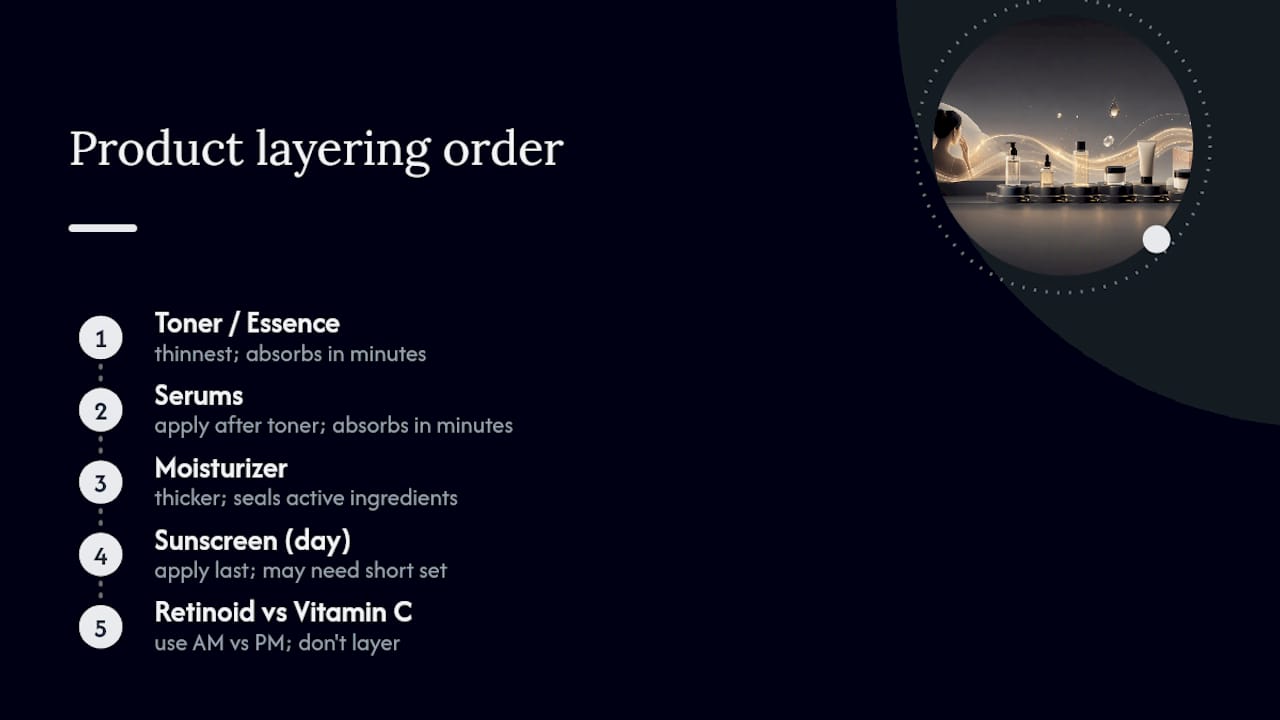
What’s mythical is the idea that getting the order slightly wrong ruins the whole routine. If you put a lightweight serum on before a hydrating mist instead of after, your skin will not rebel. What actually matters is that active ingredients get enough contact time with skin before you seal everything under an occlusive moisturizer, and that sunscreen always goes on as the final step during the day, not buried under makeup or oil.
One layering myth worth killing outright: that you must wait 20 to 30 minutes between every product for it to “absorb.” Most formulas absorb within a couple of minutes. The exception is sunscreen, which some formulations need a short window to set before makeup application, so check your specific product’s instructions rather than assuming a universal rule.
If you use both a retinoid and a vitamin C serum, separate them by using one in the morning and the other at night rather than layering them together, since combining certain actives can reduce effectiveness or increase irritation for sensitive skin.
Do You Really Need a Different Routine Every Season?
Swapping your entire routine every season is mostly unnecessary and can actually work against your skin. The idea took hold because skin genuinely does behave differently in humid summer air versus dry winter heat, so the instinct isn’t baseless. It’s just overstated.
What actually needs to change seasonally is usually just texture and weight, not the active ingredients doing the real work. A retinoid, for instance, doesn’t need a summer break unless you’re seeing more sun sensitivity, in which case nighttime use and diligent SPF handle that. Sunscreen absolutely never goes seasonal. UVA exposure is consistent year round, and skipping it in winter because it “feels less necessary” is one of the more damaging habits stemming from this myth.
A reasonable adjustment: swap a rich cream for a lighter lotion in summer, or add a heavier occlusive layer in winter if your barrier feels stripped. Keep your core actives, sunscreen, retinoid, and any treatment for specific concerns, running continuously. Consistency is what drives results over months, and restarting a new “seasonal” product every few months resets the adjustment period your skin needs to tolerate an active ingredient.
Are Natural Exfoliants Automatically Gentler?
Nothing about the word “natural” guarantees a product is chemical-free or gentle. Ground apricot shells, walnut husks, and sugar granules are common in “natural” scrubs, and their jagged, uneven particle edges can create microtears in skin that smooth synthetic beads or chemical exfoliants avoid entirely.

Every exfoliant, natural or synthetic, is made of chemical compounds. That’s not a loophole, it’s just chemistry. What actually determines safety is particle shape, concentration, and formulation, not whether the ingredient came from a plant. Ingredient safety and efficacy depend on formulation and testing, not on a “natural” label slapped on the front of a jar.
Chemical exfoliants like glycolic acid, lactic acid, or salicylic acid dissolve dead skin cells evenly across the surface rather than physically scraping them off. For most skin types, that’s a gentler and more consistent result than a gritty scrub, natural or not. If you have sensitive or reactive skin, a mild chemical exfoliant used a couple of times weekly usually outperforms any “all-natural” scrub in both comfort and results.
Does Wearing Makeup Cause Breakouts?
Makeup doesn’t cause acne by default. Certain formulations do, and the distinction matters more than most people realize. Comedogenic ingredients, heavy oils, certain waxes, some silicones in poorly formulated products, clog pores and trigger breakouts in acne-prone skin. Products labeled non-comedogenic are specifically tested to minimize that risk.
The bigger issue is usually hygiene and removal, not the makeup itself. Sleeping in a full face of foundation, reusing dirty brushes, or skipping a proper cleanse at night creates far more breakout risk than the makeup formula does on its own. Skin that’s already prone to acne needs extra care in product selection, but that’s a matter of formulation choice, not an inevitable consequence of wearing makeup at all.
If breakouts show up consistently along your jawline or cheeks after switching products, check the ingredient list for known pore-cloggers before assuming makeup as a category is the problem.
Does Hot or Cold Water Change Your Pore Size?
Pores don’t have muscles, so they can’t physically open or close in response to water temperature. This is one of the most repeated skincare myths, and it survives because warm water genuinely does make pores look temporarily larger by softening the debris and oil sitting inside them, creating an illusion of size change.
Cold water causes surrounding skin to constrict slightly and reduces visible redness or puffiness, which can make pores look smaller for a few minutes. Neither effect touches actual pore structure at all. Once your skin returns to its normal temperature, pore appearance goes right back to where it started.
Warm (not hot) water is still the better choice for cleansing, since it helps dissolve oil and makeup more effectively without stripping the skin barrier the way genuinely hot water can. Finish with a lukewarm rinse if you want, but treat it as a comfort preference, not a pore-control technique.
Should You Ever Pop a Pimple Yourself?
Popping a pimple almost always makes things worse. Manual extraction pushes bacteria and inflamed material deeper into surrounding tissue instead of removing it, which frequently spreads the infection and extends how long the blemish sticks around. It also significantly raises the odds of post-inflammatory hyperpigmentation or permanent scarring, especially on skin of color, where dark marks can linger for months after the original blemish clears.
A better approach depends on the type of blemish. A whitehead close to the surface with a visible head sometimes resolves faster with a clean extraction by a professional, using sterile tools. Everything else, cystic acne, deep inflamed bumps, anything without a clear surface point, should be left alone entirely.
Spot treatments with benzoyl peroxide or salicylic acid reduce inflammation and speed healing without the trauma of manual extraction. For persistent or painful breakouts, a dermatologist can perform an in-office extraction or recommend a targeted treatment, which carries far less scarring risk than a bathroom mirror and a fingernail.
A Few Honest Notes From the Research
Sorting through dermatology research for this piece, one thing stood out: the myths that survive longest aren’t the obviously wrong ones, they’re the ones with a kernel of truth stretched too far. Retinol does cause some initial flaking, so “it thins your skin” felt believable for years. If a habit isn’t backed by a dermatologist or a clinical study, treat it as a guess, and see a professional before self-treating anything that’s painful, spreading, or not improving after a few weeks. Cellure’s own research on how science is reshaping anti-aging skincare shaped a lot of the framing here, particularly around what “evidence-backed” should actually mean to a shopper.
A Science-Forward Option for Your Next Step
If the myths above taught you anything, it’s that formulation and evidence matter more than marketing claims or price tags. Cellure builds its serums and kits around actives with real clinical support, peptides, tranexamic acid, hyaluronic acid, and polynucleotides, aimed specifically at barrier repair, firmness, and tone rather than vague “anti-aging” promises.
This article appears on Cellure’s own site, and that’s worth saying plainly. If you want a single, curated starting point instead of piecing together separate products, the Complete Skin Repair Kit bundles barrier-focused actives so you’re not guessing which ingredients belong together. For more on ingredient selection, Cellure’s guide to clinically supported skincare walks through how to evaluate formulations the way a dermatologist would. Browse the kit and see which actives your current routine might be missing.
Frequently Asked Questions
What is the biggest skincare myth people still believe? That sunscreen is only necessary on sunny days. UVA rays penetrate cloud cover and window glass, so daily use matters more than most people realize.
How long does it take to see results from a retinoid? Most people notice texture changes within 6 to 12 weeks, with continued collagen-related improvement over several months of consistent use.
Do expensive skincare products actually work better than drugstore options? Not automatically. Efficacy comes down to active ingredient concentration and formulation, not price or packaging.
Can you actually make your pores smaller? No. Pore size is genetically determined, but exfoliation, niacinamide, and retinoids reduce how visible they appear.
Is it true that oily skin doesn’t need moisturizer? No. Skipping moisturizer can trigger more oil production. A lightweight, non-comedogenic formula keeps oily skin balanced.
This article is general information, not a substitute for advice from a qualified doctor. Consult a qualified healthcare professional about your own circumstances before acting on anything here.
Sources
- Don’t fall for these skin myths - Harvard Health
- 10 Common Skincare Myths, Explained | Vogue
- 8 Skincare Myths Debunked by a Dermatologist
- Skin care Myths Debunked by Dermatologists | Facts vs Fiction
Recommended
Share