


Gentle Exfoliation Guide for Sensitive and Aging Skin
TL;DR:
- Gentle exfoliation removes dead skin cells without damaging the skin barrier, especially important for aging or sensitive skin. Chemical options like PHAs and low-strength lactic acid are safest, working by dissolving bonds and adding moisture, while physical exfoliants should be very gentle. Proper preparation, technique, and post-exfoliation care, including barrier support and sun protection, maximize benefits and minimize irritation.
Gentle exfoliation is the controlled, mild removal of dead skin cells that supports skin renewal without damaging the skin barrier or triggering irritation. For adults with aging or sensitive skin, this distinction matters more than most skincare advice acknowledges. Dead cell buildup thickens over time, dulling tone, blocking product absorption, and making fine lines look deeper than they are. A well-executed guide to gentle exfoliation gives you a clear path to smoother, brighter skin without the redness and setbacks that come from pushing too hard. The key is choosing the right method, the right concentration, and the right frequency for your skin’s actual tolerance.
What are the best gentle exfoliation methods for sensitive and aging skin?
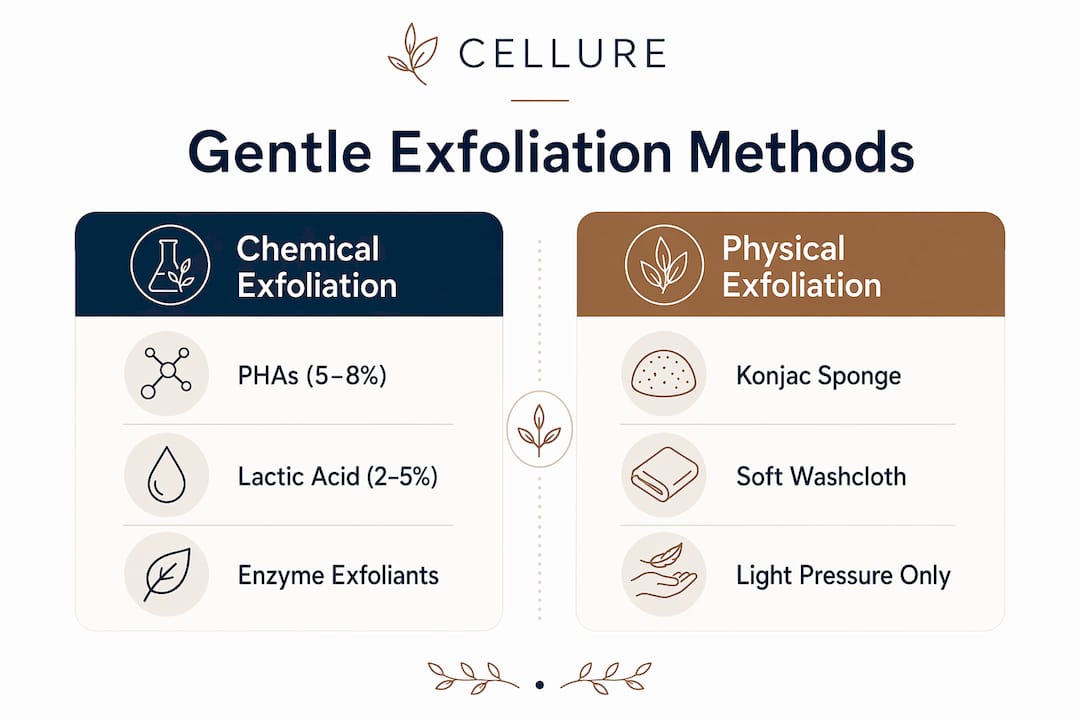
The two main categories of exfoliation are chemical and physical. For sensitive and aging skin, chemical exfoliation is the more consistent and safer choice. It works by dissolving the bonds between dead cells rather than scrubbing them off, which means less friction and less risk of micro-tears.
PHAs at 5–8% and low-strength lactic acid at 2–5% are the safest effective options for chemical exfoliation on sensitive skin. PHAs (polyhydroxy acids) have a larger molecular size than AHAs, so they penetrate more slowly and cause less stinging. Lactic acid at low concentrations also draws moisture into the skin while it exfoliates, which makes it especially well-suited for mature skin that tends toward dryness.
Enzyme exfoliants are another strong option. Papain (from papaya) and bromelain (from pineapple) break down dead skin proteins without any acid activity at all. They work at the surface only, making them ideal for skin that reacts to acids even at low concentrations.
For physical exfoliation, the rule is simple: soft only. A konjac sponge or a clean, soft washcloth used with light pressure is the upper limit for sensitive and aging skin. Harsh scrubs with walnut shell or sugar granules, and motorized brushes, create friction that thins the skin barrier over time.
| Exfoliant type | How it works | Best for | Caution |
|---|---|---|---|
| PHAs (5–8%) | Dissolves cell bonds slowly | Sensitive, dry, aging skin | Avoid if allergic to lactones |
| Lactic acid (2–5%) | Dissolves bonds, adds moisture | Dry, mature skin | Start low, patch test first |
| Enzyme exfoliants | Breaks down surface proteins | Reactive, rosacea-prone skin | Check for fruit allergies |
| Konjac sponge | Gentle physical buffing | All sensitive skin types | Replace monthly |
| Soft washcloth | Light manual exfoliation | Beginners | Use zero pressure |
Pro Tip: Chemical exfoliation tends to be more consistent than physical methods for sensitive skin because you control the concentration, not the pressure.
How to prepare your skin and choose the right products
Preparation determines how well exfoliation works and how little irritation you get. Start with a gentle, non-stripping cleanser to remove sunscreen, oil, and makeup before applying any exfoliant. Applying an exfoliant over residue reduces its contact with actual skin and increases the chance of uneven results.

Product selection should prioritize formulations that support the skin barrier alongside the exfoliant itself. Barrier support using ceramides and humectants before and after exfoliation reduces irritation risk significantly. This means the moisturizer you use matters as much as the exfoliant you choose.
Patch testing is non-negotiable for sensitive and aging skin. Apply a small amount of the product to your inner arm or behind the ear for 48 hours before using it on your face. If no redness or stinging appears, proceed with a single weekly application for the first month before considering any increase in frequency.
Qualities to prioritize when selecting a gentle exfoliating product:
- Low acid concentration (PHAs at 5–8%, lactic acid at 2–5%)
- pH-balanced formula (ideally between 3.5 and 4.5 for acids)
- Contains ceramides, glycerin, or hyaluronic acid in the formula
- Fragrance-free and alcohol-free
- Dermatologist-tested for sensitive skin
For adults new to exfoliation, Cellure’s gentle skincare approach offers evidence-based guidance on building a safe routine from the ground up.
How to exfoliate gently: step-by-step technique and frequency
Technique matters as much as product choice. Rushing the process or applying too much product are two of the most common reasons people experience irritation even with gentle formulations.
Follow these steps for safe, effective exfoliation at home:
- Cleanse your face with a gentle, sulfate-free cleanser and pat dry completely.
- Wait 5–10 minutes after cleansing before applying your exfoliant. Damp skin absorbs acids faster and deeper, which increases irritation risk.
- Apply a thin, even layer of your chosen exfoliant. Apply acids to dry skin initially to reduce absorption depth and minimize irritation.
- Leave on for the time specified on the product (usually 5–10 minutes for a rinse-off formula, or as directed for leave-on formulas).
- Rinse thoroughly with cool water if using a rinse-off product.
- Apply a ceramide-rich moisturizer immediately while skin is still slightly damp.
- Use SPF 30+ the following morning without exception. Freshly exfoliated skin is more vulnerable to UV damage.
Frequency is where most people go wrong. Start with once a week for the first month before increasing to twice weekly if your skin tolerates it well. For mature and sensitive skin specifically, once every 7–10 days using gentle enzyme or PHA-based exfoliants is the expert-recommended ceiling.
| Skin type | Starting frequency | Maximum frequency |
|---|---|---|
| Sensitive | Once per week | Once every 7–10 days |
| Mature/aging | Once per week | Once every 7–10 days |
| Normal | Once per week | Twice per week |
| Dry | Once per week | Once every 7 days |
Pro Tip: If your skin feels tight or looks shiny and raw after exfoliating, that is a signal to reduce frequency, not to push through.
How to maintain skin health after exfoliation
Post-exfoliation care determines how much of the benefit you actually keep. Exfoliation removes the outermost layer of dead cells, which temporarily increases transepidermal water loss. Applying a moisturizer with ceramides and glycerin within two minutes of rinsing locks in hydration before that loss occurs.
Proper exfoliation improves product absorption, which means the serums and treatments you apply afterward work more effectively. This is one of the most underappreciated benefits of gentle exfoliation. A peptide serum applied to freshly exfoliated skin penetrates more efficiently than the same serum applied over accumulated dead cells.
Daily SPF 30+ use is not optional after exfoliation. Newly exfoliated skin has a thinner protective layer and burns more easily. Skipping sun protection after exfoliating is one of the fastest ways to undo the results and cause post-inflammatory pigmentation.
Ingredients to prioritize for barrier repair after exfoliation:
- Ceramides (ceramide NP, AP, EOP): rebuild the lipid barrier
- Glycerin: draws water into the skin from the environment
- Hyaluronic acid: holds moisture at multiple skin depths
- Niacinamide: calms redness and supports barrier function
- Panthenol (vitamin B5): soothes and accelerates barrier recovery
Gentle exfoliation complements barrier hydration and sun protection. It does not replace either. Think of exfoliation as preparation, not treatment.
Common mistakes and how to troubleshoot them
Over-exfoliation is the most common problem, and it often disguises itself as a product failure. If skin feels tight, stings, or reddens, reduce exfoliation frequency immediately. Do not switch to a stronger product assuming the current one is not working.
Avoid using body exfoliants or harsh tools on facial skin. Facial skin is thinner and more vulnerable to damage from improper exfoliation choices. Body scrubs are formulated for thicker skin on the arms, legs, and torso. Using them on the face causes micro-tears that are invisible to the eye but measurable in barrier damage.
Mixing strong actives on the same day as exfoliation is another frequent mistake. Retinoids, vitamin C at high concentrations, and benzoyl peroxide all increase skin sensitivity. Using any of these on the same day as an acid exfoliant compounds irritation risk. Alternate them on different nights.
Signs you need to pause exfoliation entirely:
- Persistent redness lasting more than 24 hours after exfoliating
- Burning or stinging that does not resolve within minutes of rinsing
- Skin that feels raw, tight, or unusually dry for several days
- New breakouts or texture changes appearing after exfoliation
When these signs appear, stop exfoliating for at least two weeks. Focus on barrier repair with ceramides and glycerin. Consult a dermatologist if symptoms persist beyond two weeks. Tracking your skin’s response over time helps you spot patterns. Cellure’s guide on signs of effective skincare offers a practical framework for reading those signals accurately.
Pro Tip: Your skin’s response is a better guide than any schedule. If it looks calm and feels smooth, you are doing it right. If it looks irritated, pull back.
Key Takeaways
Consistent, low-level exfoliation with barrier support is more effective than aggressive treatments for aging and sensitive skin.
| Point | Details |
|---|---|
| Choose chemical over physical | PHAs at 5–8% and lactic acid at 2–5% are safest for sensitive and aging skin. |
| Start once weekly | Begin with one session per week and increase only if skin tolerates it after a full month. |
| Apply to dry skin | Applying acids to dry skin reduces absorption depth and lowers irritation risk. |
| Repair the barrier after | Use ceramides and glycerin immediately post-exfoliation to prevent moisture loss. |
| SPF is non-negotiable | Daily SPF 30+ protects newly exfoliated skin from UV damage and pigmentation. |
What I’ve learned from years of watching people over-exfoliate
The most common mistake I see is treating irritation as a sign that the exfoliant is working. It is not. Redness and stinging mean the skin barrier is under stress, not that dead cells are being cleared more effectively. Consistent, low-level renewal is more effective than aggressive treatments for aging or sensitive skin. That is not a soft opinion. It is what the evidence consistently shows.
What surprises people most is how little exfoliation aging skin actually needs. Once a week, with a low-strength PHA or enzyme formula, produces visible results within four to six weeks. The patience required feels counterintuitive when you are used to seeing skincare marketed as fast and dramatic. But the skin’s renewal cycle takes roughly 28 days in younger skin and longer as we age. Rushing that process does not speed it up.
The other thing I would push back on is the idea that exfoliation is the centerpiece of an anti-aging routine. It is a supporting step. Barrier repair, hydration, and sun protection do more for long-term skin health than any exfoliant. Exfoliation makes those steps work better. That is its actual role, and understanding it that way changes how you approach the whole routine.
— Sara
Cellure’s Complete Skin Repair Kit: a natural next step
After exfoliation, your skin is primed to absorb what you put on it. That is exactly when barrier repair ingredients do their best work.
Cellure’s Complete Skin Repair Kit is formulated with peptides, humectants, and bioactive ingredients that support skin renewal at the cellular level. It pairs directly with the post-exfoliation window, delivering the hydration and barrier support your skin needs most after dead cells are cleared. The kit is designed for sensitive and aging skin, with gentle formulations that complement rather than compete with your exfoliation routine. For adults building a results-driven routine around safe exfoliation practices, it offers a structured next step backed by regenerative science.
FAQ
What is the safest exfoliant for aging skin?
PHAs at 5–8% and lactic acid at 2–5% are the safest chemical exfoliants for aging skin. They work gently, minimize stinging, and support moisture retention at the same time.
How often should sensitive skin be exfoliated?
Sensitive skin should be exfoliated once every 7–10 days using a gentle enzyme or PHA-based formula. Starting with once weekly for the first month before any increase is the standard expert recommendation.
Can I exfoliate if my skin barrier is already damaged?
No. Pause exfoliation entirely if your skin feels raw, tight, or persistently red. Focus on barrier repair with ceramides and glycerin for at least two weeks before reintroducing any exfoliant.
Should I apply exfoliant to wet or dry skin?
Apply acid exfoliants to dry skin. Damp skin absorbs acids faster and deeper, which increases the risk of irritation, especially for sensitive or compromised skin.
Does exfoliation replace moisturizing?
Exfoliation does not replace moisturizing. It prepares the skin to absorb moisturizers more effectively. Applying a ceramide-rich moisturizer immediately after exfoliating is a required step, not optional.