


48 Hour Patch Test for Skincare: 7–10 Day Repeat and Safe Serum Steps
Yes. Patch test any new leave-on product or active ingredient before applying it to your face. Rub a small amount on your inner forearm or behind your ear, leave it alone, and watch the spot for about a day to two days before you commit to full use. For stronger actives, repeat the application once or twice daily for several days, since some reactions can take that long to show up.
TL;DR:
- Patch testing should be done on the inner forearm or behind the ear for 24 to 48 hours, applying a small amount of product at a time.
- Individuals with reactive skin, eczema, or allergies need to patch test skincare more carefully, especially with actives like retinoids, acids, or sunscreens.
- If a reaction appears after 24 hours, especially involving swelling or spreading redness, seek medical advice and discontinue use immediately.
- Fragrance, preservatives, metals, and certain chemical filters are the most common causes of skincare allergies, but labels like hypoallergenic are not guaranteed to be safe.
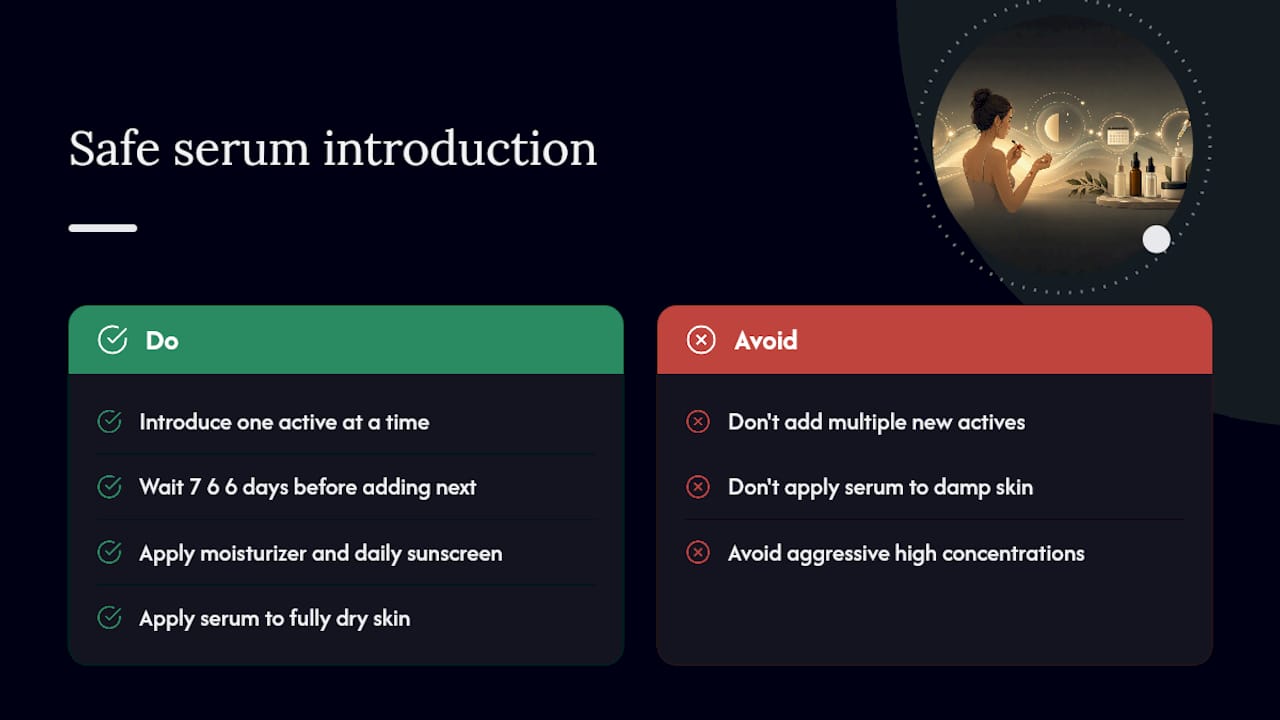
- Introducing new active ingredients should be gradual, starting with every other day for two weeks, then increasing frequency only if no adverse signs appear.
Table of Contents
- What is patch test skincare and how does it differ from a dermatologist’s version?
- Who really needs to patch test, and when does it matter most?
- Step-by-step patch test protocol for leave-on, rinse-off, and high-actives
- How do you read the results of a skincare sensitivity test?
- Which ingredients cause the most skincare reactions?
- How do you introduce a new active after a clean patch test?
- When should you stop testing and call a doctor?
- Cellure’s approach to introducing regenerative serums safely
- A note on patience from Sara
- Start your regimen with a kit built for cautious skin
- Where this article’s guidance comes from
- Sources
What is patch test skincare and how does it differ from a dermatologist’s version?
A home patch test is a small, controlled trial run: you apply a product to a limited patch of skin and watch for irritation or allergy before it touches your face. It’s a screening tool, not a diagnosis. Medical News Today notes that home testing catches irritation and many allergic responses but doesn’t replace formal dermatology patch testing, which uses standardized allergen panels read by a professional over several days.
What a home test can catch: immediate stinging, redness, and many common allergens. What it often misses: slow-building sensitization from months of use, and photoallergic reactions that only appear with sun exposure. Before you start, confirm three things:
- Skin at the test site is clean, dry, and free of lotion or makeup
- You’re not testing over broken, shaved, sunburned, or already irritated skin
- You’re testing one product at a time, not stacking several
Who really needs to patch test, and when does it matter most?
Anyone can benefit from testing, but some people can’t afford to skip it. If you have a history of skin reactions, eczema, rosacea, or generally reactive skin, treat patch testing as non-negotiable rather than optional.
Certain product categories deserve extra caution regardless of your skin history:
- Leave-on actives like retinoids, vitamin C, and acids
- Chemical or mineral sunscreens, especially new formulations
- Hair dyes and henna, which carry some of the highest allergy rates in cosmetics
- Botanical extracts, essential oils, and heavily fragranced products
For children, patch test the same way but use an even smaller amount and shorter initial exposure. If a child has known allergies, asthma, or a history of eczema flares, check with a pediatrician or dermatologist before introducing anything new.
Step-by-step patch test protocol for leave-on, rinse-off, and high-actives
The American Academy of Dermatology recommends applying a small amount to a quarter-sized area, most commonly the inner forearm or the crook of the elbow. Behind the ear works too, and it’s a smart choice for facial products since the skin there behaves similarly to facial skin. Here’s the exact sequence to follow:
- Clean the site. Wash and dry your inner forearm or the spot behind your ear.
- Apply a normal-use amount. Don’t drown the spot. Use roughly what you’d apply in a real application, at the product’s usual thickness.
- Leave it uncovered unless the product instructions say otherwise. Occlusion (covering with a bandage) can trap heat and produce a false irritant reaction.
- Check immediately. Look for instant stinging, burning, or flushing. That’s often just irritation, not allergy.
- Check again at 24 and 48 hours. This window catches most contact reactions.
- For actives you plan to use regularly (retinoids, acids, peptide serums, fragranced products), reapply once or twice daily for 7 to 10 days. Delayed allergic reactions can take that long to surface.
- Photograph the site each day. A photo record catches subtle changes your memory won’t.
- Note the batch number and expiry date. If a reaction happens weeks later, you’ll want to know exactly what you tested.
- Never test more than one new product at a time. If two products cause a reaction together, you won’t know which one is responsible.
Rinse-off products like cleansers and masks need less time. Leave a cleanser on the test patch for about 5 minutes, then rinse and check the same way you would a leave-on product. Masks and peels should follow the product’s own contact-time instructions, but still get a full 24-hour observation afterward, since some peel ingredients cause delayed redness.
Pro Tip: Test new products on a Monday or Tuesday. If a delayed reaction shows up on day 5 or 6, you’ll still have easy access to a pharmacy or your dermatologist’s office before the weekend.
How do you read the results of a skincare sensitivity test?
Timing tells you almost everything. Immediate stinging or burning that stays confined to the test spot is usually irritant contact dermatitis. It’s uncomfortable but not an immune response, and it typically resolves once you wash the product off. Delayed itching, spreading redness, swelling, or small fluid-filled bumps that show up a day or more later point toward allergic contact dermatitis, a genuine immune reaction to a specific ingredient.
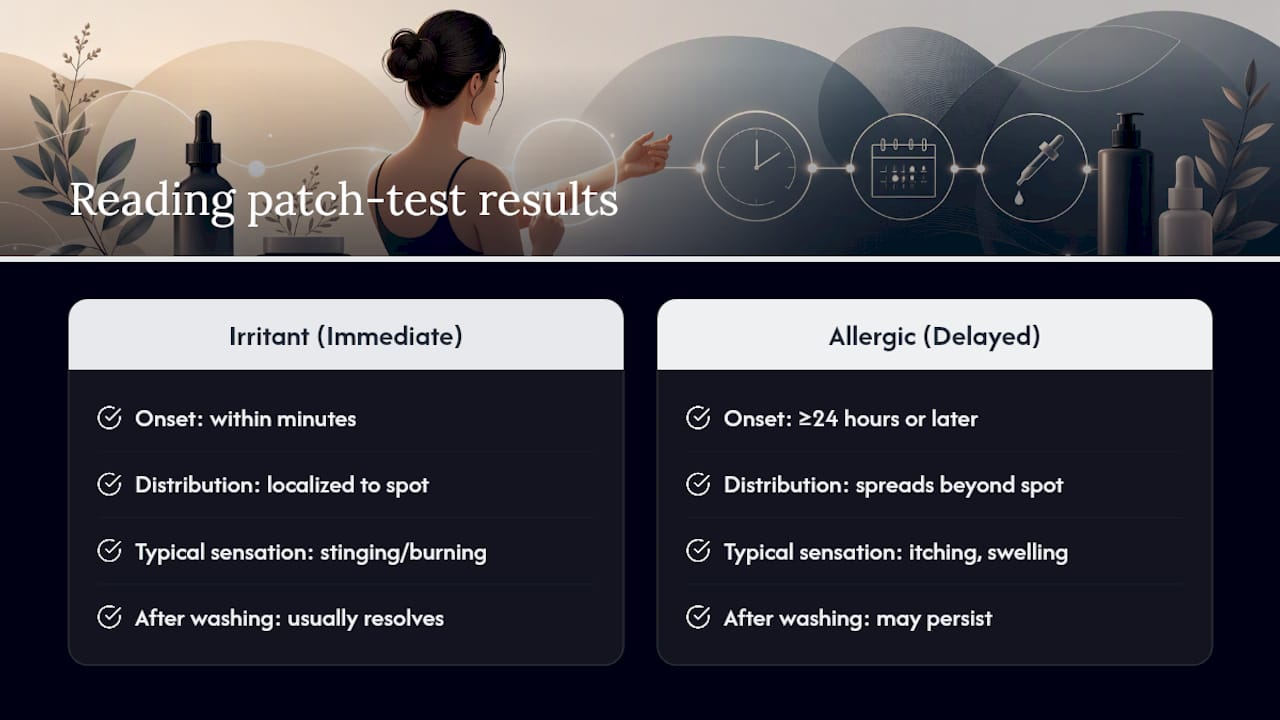
Mild irritation can often be managed at home with a cool compress and a bland moisturizer like plain petroleum jelly. But Healthline advises washing off immediately and seeking medical advice if you notice hives, significant swelling, blistering, or any trouble breathing.
This isn’t a rare concern. Clinical reviews of contact dermatitis cases consistently identify personal care products as a leading trigger, which is exactly why a two-minute test before full use is worth the patience.
Which ingredients cause the most skincare reactions?
Fragrance mixes and preservative systems top the list of cosmetic allergens in clinical reports, according to DermNet NZ, followed by essential oils, certain metals, and some chemical sunscreen filters. Labels reading “hypoallergenic” or “unscented” aren’t guarantees. They’re marketing terms with no regulated definition, so they can still contain allergens.
- Fragrance and essential oils: among the most common cosmetic allergens
- Preservatives (formaldehyde releasers, certain parabens): frequent culprits in leave-on products
- Metals like nickel: relevant in some pigmented or mineral formulas
- Low-pH acids and retinoids: usually irritants, not allergens, but painful if overused
For acids and retinoids, test behind the ear at a lower concentration or shorter contact time first. Full-strength testing on sensitive skin often produces predictable irritation that has nothing to do with allergy. Oxidized natural oils and expired products are their own hazard: once an oil turns rancid, its breakdown compounds can irritate skin that tolerated the fresh version just fine.
How do you introduce a new active after a clean patch test?
A negative patch test means the product is safe to try, not safe to use at full strength immediately. Ease in with this cadence:
- Weeks 1 to 2: Apply every other day, watching for cumulative irritation rather than just the initial reaction.
- Weeks 3 to 4: Increase to daily use if skin tolerates the every-other-day schedule without redness or flaking.
- Ongoing: Introduce only one new active at a time. Keep the rest of your routine simple, including a moisturizer and daily sunscreen, while you monitor.
If subtle redness, tightness, or flaking shows up after weeks of fine use, stop and reassess. Sensitization can build slowly, and a product that passed its patch test can still cause trouble months later.
When should you stop testing and call a doctor?
Stop immediately and seek emergency care if you notice throat or tongue swelling, difficulty breathing, or fainting. Those are signs of a severe allergic reaction, not something to wait out.
See a dermatologist or allergist for formal patch testing if you get recurring rashes, reactions that involve your eyelids, or facial flare-ups you can’t trace to a specific product. Formal clinical patch testing uses standardized allergen panels applied to the back and read over 72 to 96 hours, offering a level of precision no home test can match.
Cellure’s approach to introducing regenerative serums safely
A clean patch test is only step one. When you’re layering in a new serum with peptides, tranexamic acid, or polynucleotides, introduce one active at a time and give your skin barrier time to adjust before adding the next. Cellure formulates with this caution in mind, favoring gentler concentrations and kit-based sequencing over one aggressive formula.
If you have a complicated reaction history, a quick consult with a dermatologist before starting a new regimen is worth the appointment. For everyone else, moisturizer and daily sunscreen alongside any new active reduce the odds of a rough transition.
Pro Tip: If you’re stepping up from a basic moisturizer to an active serum, apply the new product on freshly cleansed, fully dry skin. Damp skin absorbs faster, which can mean more irritation, not better results.
A note on patience from Sara
Patch testing feels like a small, almost silly step when you’re excited about a new serum. It isn’t. The 48 hours you spend watching a spot on your arm is the cheapest insurance you’ll ever buy for your face. I’ve seen how much faster people abandon good products entirely after one bad, avoidable reaction. Test first. Your skin’s long game depends on it.
— Sara
Start your regimen with a kit built for cautious skin
Once your patch test comes back clean, the harder part is sequencing new actives without overwhelming your barrier. That’s exactly what Cellure’s Complete Skin Repair Kit is built to solve: a curated set of serums formulated to be introduced step by step, rather than one aggressive product you’re guessing how to layer.

Each formula in the kit uses the same gentle-but-effective philosophy: peptides, tranexamic acid, and polynucleotide-based actives at concentrations designed to work with sensitive skin, not against it. If you’ve patch tested and you’re ready to build a real routine instead of experimenting product by product, check out the Complete Skin Repair Kit and start with the first step in the sequence.
Where this article’s guidance comes from
The AAD supplies the core testing protocol; Medical News Today and Healthline cover clinical distinctions and safety red flags; NCBI/PMC backs the contact dermatitis prevalence data.
This article is general information, not a substitute for advice from a qualified doctor. Consult a qualified healthcare professional about your own circumstances before acting on anything here.
Sources
- How to test skin care products — AAD
- How to perform a patch test for skincare products — Medical News Today
- How to do an at-home skin patch test — Healthline
Recommended
Share