


Why Target Uneven Skin Tone for Radiant Aging
Finding genuine solutions for uneven skin tone can feel frustrating, especially as subtle patches or spots become more noticeable with every birthday. Uneven skin tone is a natural result of normal processes like sun exposure, hormonal changes, and inflammation, not always a sign of serious disease or neglect. Understanding what actually causes these visible changes, along with the common misconceptions, empowers you to focus on gentle, proven skincare that supports your skin’s renewal at the cellular level.
Table of Contents
- Defining Uneven Skin Tone And Common Misconceptions
- Types And Causes Of Skin Tone Irregularities
- Visible Effects Of Uneven Skin Tone On Aging
- Science-Backed Approaches To Even Skin Tone
- Risks Of Ignoring Unevenness And Preventive Strategies
Key Takeaways
| Point | Details |
|---|---|
| Understanding Uneven Skin Tone | Uneven skin tone is caused by melanin fluctuations and manifests in hyperpigmentation, hypopigmentation, or dullness, not necessarily indicating serious health issues. |
| Misconceptions About Treatment | Many believe uneven skin tone is permanent, but targeted skincare can effectively address discoloration over time with consistent application. |
| Prevention is Key | Daily use of broad-spectrum sunscreen is essential to prevent new pigmentation issues while treating existing discoloration. |
| Importance of Professional Evaluation | Regular skin checks by a dermatologist can help monitor changes in pigmentation and address potential health risks early. |
Defining Uneven Skin Tone and Common Misconceptions
Uneven skin tone sounds straightforward, but the reality is more nuanced than most people realize. At its core, uneven skin tone refers to visible color variations across your face and body caused by fluctuations in melanin production. These irregularities manifest in three main ways: darker patches (hyperpigmentation), lighter patches (hypopigmentation), or complete loss of pigment.
You’ve probably noticed this yourself. One cheek might appear slightly darker than the other, or a spot on your forehead looks more golden than your chin. This isn’t vanity talking—it’s a completely normal skin response to aging and environmental stress.
What Uneven Skin Tone Actually Looks Like
Uneven tone appears differently depending on your skin’s characteristics:
- Hyperpigmentation: Dark patches, age spots, or melasma (larger brown areas on cheeks, nose, or forehead)
- Hypopigmentation: Light spots where pigment is reduced but not entirely absent
- Post-inflammatory changes: Discoloration following acne, eczema, or injury that can persist for months
- General dullness: A loss of that luminous quality that makes skin look youthful and vibrant
Uneven skin tone results from benign processes like sun exposure, hormonal fluctuations, or skin inflammation—not from serious disease.
Women in your age range (30-50) experience uneven tone particularly because cumulative sun exposure finally becomes visible, hormone shifts affect melanin production, and skin cell turnover naturally slows. This isn’t a sign something is wrong; it’s your skin’s honest record of living.

The Misconceptions That Hold You Back
Here’s where most people get it wrong. The biggest misconception? That uneven skin tone always signals a serious dermatological condition requiring aggressive intervention. That’s simply not accurate.
Another false belief: that your natural skin tone variation is permanent and unchangeable. Postinflammatory pigmentation changes frequently respond well to targeted skincare, especially when addressing the underlying inflammation or cellular damage.
You might also believe that uneven tone is purely cosmetic. Research shows it affects mental health and quality of life far more than dismissed previously. When you feel self-conscious about your complexion, you’re less likely to engage socially, be photographed, or pursue activities you enjoy.
Many women also underestimate their own skin’s capacity for change. Your skin cells regenerate constantly. At the cellular level, targeted treatment can support this natural renewal process, gradually shifting how your skin appears.
Why This Matters for Radiant Aging
Achieving a radiant appearance isn’t about erasing your skin’s history. It’s about supporting your skin’s natural capacity to look bright, even-toned, and healthy as you age. When melanin production is regulated and melanin irregularities are addressed, your skin naturally looks more youthful.
Uneven tone actually steals radiance. It disrupts light reflection across your face, making skin appear tired and dull even if you’re well-rested. An even, luminous complexion creates an impression of vitality.
This is why targeting uneven skin tone should be part of any comprehensive aging strategy—right alongside addressing firmness and volume. These concerns work together.
Pro tip: Don’t assume your uneven patches are permanent. Most discoloration responds to consistent, targeted skincare over 8-12 weeks when using formulations designed to support cellular renewal and regulate pigment production.
Types and Causes of Skin Tone Irregularities
Skin tone irregularities come in different forms, and understanding which type you’re dealing with helps you address it effectively. The variations fall into three main categories based on melanin production levels. Each behaves differently and responds to different approaches.
The Three Main Types
Your skin contains cells called melanocytes that produce melanin, the pigment responsible for your skin’s color. When something disrupts this process, you get one of three outcomes:
- Hyperpigmentation: Too much melanin in specific areas, creating dark patches or spots
- Hypopigmentation: Too little melanin, resulting in lighter patches where color is reduced
- Depigmentation: Complete absence of melanin in affected areas (the most severe form)
Most women in your age range experience hyperpigmentation rather than the other two types. You might see age spots on your hands, melasma across your cheeks, or darker patches from old acne scars.
Here’s a quick reference comparing the three main types of skin tone irregularities:
| Type | Description | Typical Appearance | Common Causes |
|---|---|---|---|
| Hyperpigmentation | Excess melanin in spots or patches | Dark spots, age spots | Sun, hormones, inflammation |
| Hypopigmentation | Reduced melanin in certain areas | Pale or lighter patches | Skin injury, eczema |
| Depigmentation | Complete melanin loss in spots | White patches | Autoimmune, severe damage |
Why These Types Develop
Understanding the cause behind your irregularities matters because it shapes your treatment strategy. The causes are numerous and often interconnected.
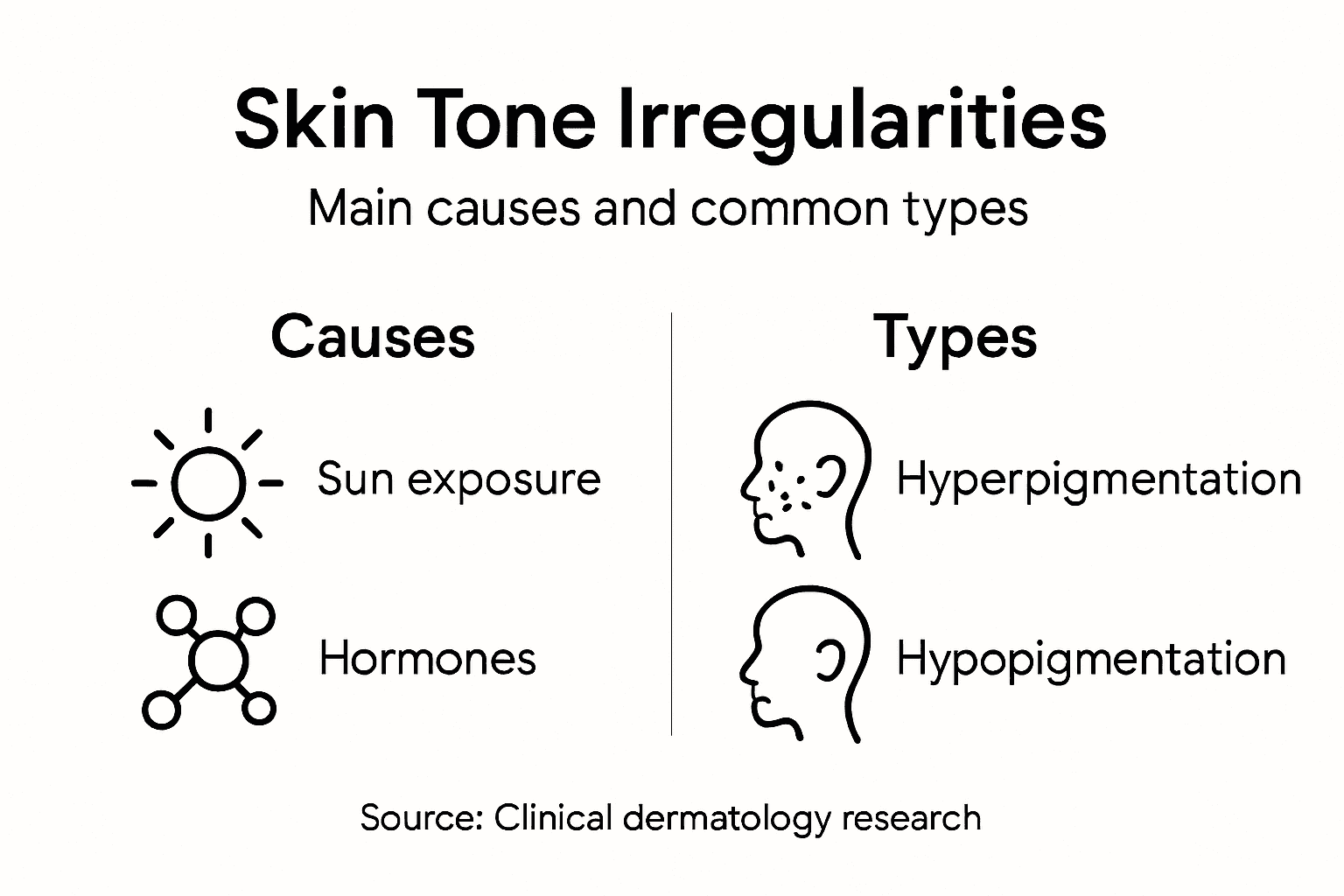
Sun exposure remains the primary culprit. UV radiation triggers melanocytes to produce more pigment as a protection mechanism. Over decades, this cumulative exposure creates visible dark spots and uneven coloring.
Hormonal changes drive a specific condition called melasma. This affects many women during perimenopause and menopause when estrogen fluctuates. You might notice a mask-like pattern of darker skin across your cheeks, forehead, or upper lip.
Post-inflammatory changes occur after your skin experiences trauma or inflammation. Acne breakouts, eczema flares, or even aggressive treatments can trigger hyperpigmentation following skin injury. The pigmentation usually fades over time but can persist for months.
The underlying cause determines how quickly your skin responds to treatment and which ingredients work best.
Other causes include certain medications (antibiotics, birth control), infections, and genetic predisposition. Some women’s melanocytes are simply more reactive to triggers than others.
How Melanin Production Gets Disrupted
Pigment cell dysfunction happens when melanocytes and the surrounding skin cells lose their communication. Environmental stress, inflammation, and aging all contribute to this breakdown.
As you age, melanocyte distribution becomes irregular. Some areas produce excess pigment while others produce less. This explains why your skin tone looks increasingly patchy in your 40s compared to your 30s.
Inflammation is a silent driver of irregularities. Even low-level inflammation from environmental pollution or lifestyle stress can nudge melanocytes toward overproduction. This is why a calming, anti-inflammatory approach to skincare matters.
Pro tip: Identify which type of irregularity dominates your skin—hyperpigmentation, hypopigmentation, or mixed—because this determines whether you need brightening, lightening, or balancing ingredients in your skincare routine.
Visible Effects of Uneven Skin Tone on Aging
Uneven skin tone doesn’t just sit on the surface of your skin. It fundamentally changes how your face looks and how old you appear to others. The effects are more dramatic than many women realize, and they compound over time.
When your skin tone is uneven, it creates visual disruption across your face. Dark patches and light spots break up the smooth color planes that make skin look youthful. Your brain registers this fragmentation as aging, even if your skin is otherwise firm and healthy.
How Uneven Tone Ages Your Face
Your skin’s radiance comes from smooth, even color and light reflection. Uneven pigmentation destroys both:
- Visual fragmentation: Dark and light patches create contrast that draws the eye and emphasizes texture
- Loss of luminosity: Discolored areas appear duller and less reflective than surrounding skin
- Emphasizes other aging signs: Uneven tone makes fine lines more visible and deepens the appearance of shadows
- Creates tired appearance: Darker patches under eyes or across cheeks mimic the look of exhaustion
You’ve probably noticed this yourself. On days when your skin tone looks even, you look more rested and vibrant. On days when spots or patches are visible, you automatically look several years older.
The Cellular Damage Underneath
The visual effects stem from real damage at the cellular level. Accumulation of cellular damage and reduced collagen and elastin create both the visible discoloration and the structural changes that make aging obvious.
As you age, your skin’s natural renewal process slows. Dead skin cells linger longer, making your complexion look dull. At the same time, melanocyte dysfunction creates those stubborn dark patches that won’t fade.
This combination creates a compounding effect. Uneven tone plus slower cell turnover plus less collagen equals a face that looks significantly older than it did five years ago.
Uneven skin tone accelerates perceived aging more than almost any other single skin concern.
The problem worsens because uneven areas are often raised or textured. A dark spot that sits slightly above the skin surface catches light differently and casts tiny shadows, making it far more noticeable.
Why This Matters for Your Appearance
Photography makes this crystal clear. In selfies, uneven tone creates harsh shadows and unflattering contrast. In professional photos, it’s often the first thing retouchers address. Your skin’s evenness directly impacts your confidence in images.
Beyond photos, uneven tone affects how you’re perceived in person. Research on facial aesthetics shows that skin evenness is one of the top markers of youth and health. When your skin tone is irregular, people unconsciously read your face as older and less vibrant.
This is why targeting uneven skin tone should be your first priority in any anti-aging routine. You can address firmness and fine lines simultaneously, but skin evenness creates the biggest visual impact.
Pro tip: In natural light, assess your skin tone using a mirror from arm’s length away. If you see distinct patches of darker or lighter color, targeting those areas will create the most dramatic improvement in your perceived age.
Science-Backed Approaches to Even Skin Tone
Targeting uneven skin tone doesn’t require guesswork. Science has identified specific ingredients and approaches that actually work. The key is understanding which strategies address your particular type of discoloration and applying them consistently.
Your skin responds to proven, evidence-based treatments. These aren’t miracle cures, but they’re clinically validated to improve hyperpigmentation and restore luminosity over time. The difference between random skincare and strategic skincare is knowing which active ingredients to use.
Topical Ingredients That Regulate Pigment
Several active ingredients have strong clinical evidence for reducing dark spots and evening skin tone:
- Niacinamide: Inhibits melanin transfer to skin cells and reduces the appearance of dark spots and discoloration
- Retinoids: Stimulate collagen production while regulating how pigment cells function, addressing both tone and texture
- Tranexamic acid: Reduces melanin production and has anti-inflammatory properties that calm reactive skin
- Vitamin C derivatives: Brighten dull areas and support collagen while inhibiting melanin synthesis
- Alpha-hydroxy acids: Increase cell turnover, removing pigmented dead skin cells faster
Niacinamide and retinoids demonstrate efficacy in clinical trials for improving hyperpigmentation and aging signs. These ingredients are accessible in over-the-counter formulations, meaning you don’t need prescription-strength treatments to see results.
The advantage? These work at the cellular level, not just on the surface. They actually shift how your melanocytes behave, creating lasting change rather than temporary coverage.
Professional Treatment Options
If topical ingredients need backup, professional treatments accelerate results. Phototherapy and chemical peels are evidence-based options that dermatologists use for stubborn discoloration.
These approaches work differently than serums. Chemical peels physically exfoliate pigmented layers. Phototherapy uses light energy to break down melanin clusters. Both can produce visible improvements in 4-8 weeks.
Consistent topical treatment for 8-12 weeks typically shows measurable improvement before considering professional procedures.
However, most women see significant results from targeted serums before reaching the professional treatment stage. Starting with the right active ingredients gives your skin time to respond naturally.
The table below summarizes common evidence-based treatments for evening skin tone:
| Approach | How It Works | Typical Results Timeline |
|---|---|---|
| Topical Ingredients | Regulate pigment and boost renewal | 8-12 weeks |
| Chemical Peels | Exfoliate pigmented skin layers | 4-8 weeks (visible) |
| Phototherapy | Breaks down melanin with light | 4-8 weeks (visible) |
| Daily Sunscreen Use | Prevents new pigmentation issues | Immediate & ongoing |
The Prevention Layer Nobody Skips
Here’s what dermatologists emphasize: prevention matters as much as treatment. Sun protection stops new discoloration from forming while you’re treating existing patches.
UV exposure is the primary driver of hyperpigmentation. Without sunscreen, your melanocytes keep producing excess pigment even as your serums try to regulate it. You’re fighting against yourself.
This is why successful skin tone evening requires both offense and defense:
- Apply brightening and regulating serums daily
- Use broad-spectrum SPF 30 or higher every single day
- Reapply sunscreen every two hours if you’re outdoors
- Give treatment at least 8-12 weeks before expecting dramatic results
Women who skip sunscreen while using pigment-regulating serums typically see slower progress. The combination is what creates momentum.
Realistic Timeline and Expectations
Uneven skin tone doesn’t develop overnight, and it won’t resolve overnight. Most clinical studies show measurable improvement after 8-12 weeks of consistent application. By week 16, results become quite obvious.
Dark spots that have been present for years may need longer. Newer discoloration from acne or inflammation typically responds faster.
The consistency matters more than the strength. Daily application of a gentle, effective serum outperforms weekly use of a stronger treatment.
Pro tip: Layer your treatment serum with a hydrating moisturizer to improve penetration and reduce irritation, allowing your skin to tolerate active ingredients better and show results faster.
Risks of Ignoring Unevenness and Preventive Strategies
Ignoring uneven skin tone isn’t just a cosmetic choice. It can mask deeper skin health issues and contribute to long-term damage that becomes harder to reverse. Understanding the risks motivates action before problems compound.
Uneven pigmentation often signals that your skin needs attention. Leaving it unaddressed means missing opportunities for early intervention. The longer you wait, the more entrenched the discoloration becomes and the more cellular damage accumulates underneath.
Health Risks Beyond Appearance
Pigmentation irregularities deserve attention for reasons beyond vanity. Dark spots and uneven areas can sometimes indicate underlying conditions that deserve medical evaluation. Dismissing all discoloration as benign means potentially overlooking something that needs professional assessment.
Skin cancer risk is the most serious concern. Cumulative UV exposure increases risks of skin damage and skin cancers, particularly when sun damage has already created visible pigmentation changes. Uneven tone is often a sign your skin has absorbed significant UV radiation.
This doesn’t mean every dark spot is cancer. But it does mean that skin showing uneven pigmentation deserves regular monitoring and professional skin checks. Dermatologists can distinguish between benign spots and concerning changes.
Uneven skin tone is your skin’s honest feedback about cumulative sun exposure and cellular stress.
Why Early Action Matters
Discoloration that’s addressed in its early stages responds faster to treatment. A melasma patch you’ve had for two years takes longer to fade than one you target within three months.
Delayed action also means more sun damage accumulates. Every summer without sun protection deepens existing patches and creates new ones. What could have been corrected with 8-12 weeks of treatment now requires months of consistent care.
There’s also a psychological cost. Women who feel self-conscious about their skin tend to avoid dermatologists, skip professional treatments, and isolate socially. Early intervention prevents this spiral.
Essential Preventive Strategies
Prevention works better than correction. These foundational approaches stop problems from worsening:
- Daily broad-spectrum sunscreen (SPF 30+): Non-negotiable year-round, even on cloudy days
- Reapplication every two hours: Especially during outdoor activities or after swimming
- Antioxidant protection: Use vitamin C or similar ingredients to defend against environmental stress
- Regular skin checks: Monitor existing spots for changes in size, shape, or color
- Avoid harmful lightening practices: Some traditional skin lightening products contain mercury or steroids that damage skin long-term
These aren’t complicated interventions. They’re habits that take minimal effort but deliver maximum protection.
The Equity and Access Perspective
Uneven skin tone affects women with darker skin tones disproportionately. Lack of awareness and training in diverse skin presentations contributes to inequities in dermatologic care, meaning some women struggle to find providers who understand their specific concerns.
This underscores why self-education matters. Understanding your own skin empowers you to advocate for appropriate care. You become informed about what treatments work for your specific skin type and tone.
Pro tip: Schedule a baseline skin check with a dermatologist now, even if you have no obvious concerns. This creates a reference point for monitoring changes and catches early issues before they become problems.
Transform Uneven Skin Tone Into Radiant Confidence
Uneven skin tone can silently age your appearance and dim your natural glow. If you are noticing stubborn dark patches, dullness, or discoloration linked to melanin irregularities or hormonal shifts, targeted care is key to restoring your skin’s youthful vibrancy. The journey to even, luminous skin begins with understanding your skin’s unique needs and supporting its cellular renewal process with clinically backed ingredients.
Experience solutions that are designed to regulate pigment production, soothe inflammation, and enhance cell turnover. At Cellure Best Sellers, discover serums infused with potent ingredients like tranexamic acid, peptides, and polynucleotides that work gently yet effectively over consistent use.
Don’t let uneven tone steal your radiance any longer. Start your transformation today with our advanced skincare collections found on the Cellure Homepage. Visit Cellure now to explore targeted treatments that promote visible improvement in 8 to 12 weeks. Your skin’s true brightness awaits—take the first step to radiant aging now!
Frequently Asked Questions
What causes uneven skin tone?
Uneven skin tone is primarily caused by fluctuations in melanin production, which can result in darker patches (hyperpigmentation), lighter patches (hypopigmentation), or complete loss of pigment (depigmentation). Factors include sun exposure, hormonal changes, skin inflammation, and aging.
How can I treat hyperpigmentation at home?
To treat hyperpigmentation at home, consider using topical ingredients like niacinamide, retinoids, vitamin C derivatives, and alpha-hydroxy acids. These products can help inhibit melanin production and promote skin renewal when used consistently over time.
How long does it take to see improvements in uneven skin tone?
Most users can expect to see measurable improvements in uneven skin tone after 8-12 weeks of consistent use of targeted treatments. Dark spots that have existed longer may take more time to fade.
Is sunscreen important for preventing uneven skin tone?
Yes, daily broad-spectrum sunscreen is crucial for preventing new pigmentation issues while treating existing discoloration. It protects the skin from UV damage, which is a primary cause of hyperpigmentation.
Recommended
- Why Skin Tone Becomes Uneven – Causes and Solutions – Cellure
- TRANEXAMIC ACID PEPTIDE SERUM – Cellure
- Complete Skin Repair Kit – Cellure
- 6 Top Skin Repair Ingredients and How They Work for You – Cellure
- Laser Pigment Rejuvenation Raleigh, NC | Sun Spots + Tone
- How to Achieve Glowing Skin Naturally for Radiant Results – Passé Daisy